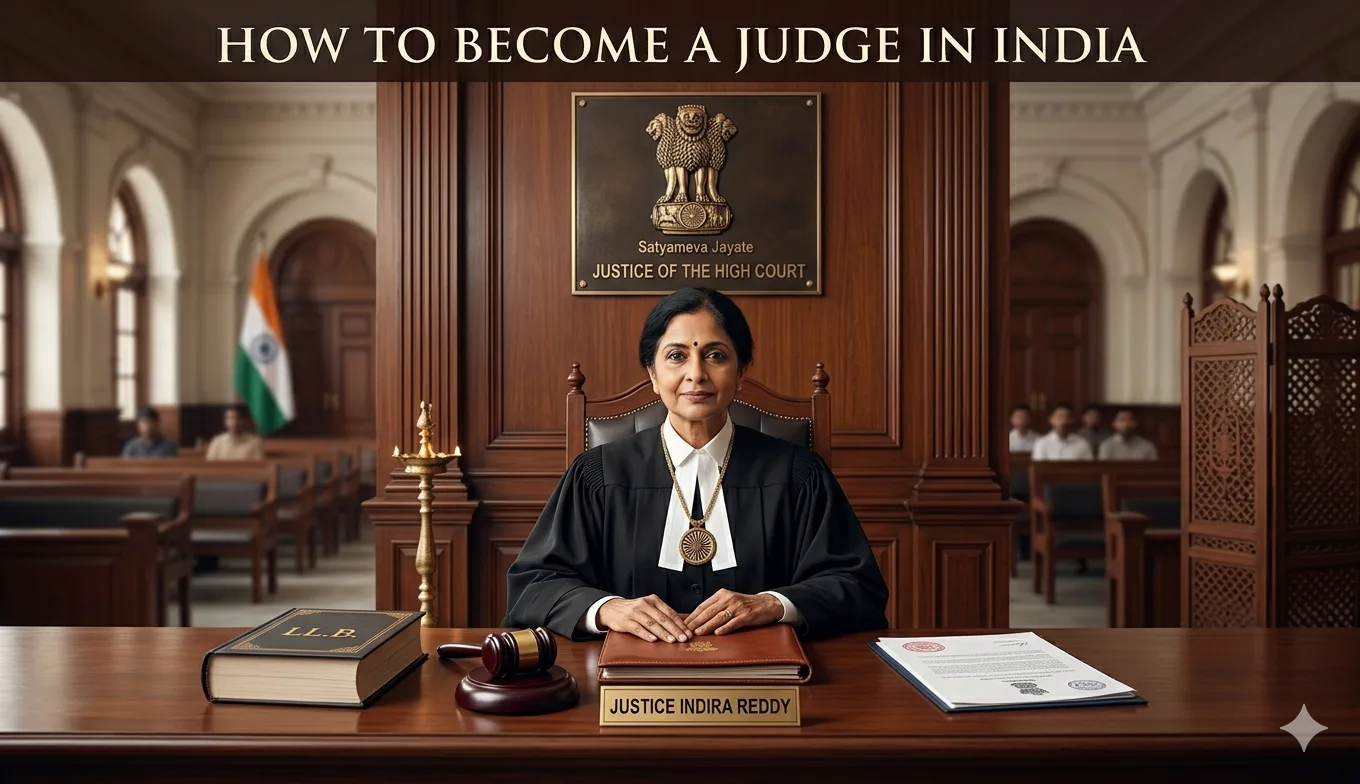
Being part of the Indian Judicial System is a blend of mixed feelings, namely, responsibility, discipline, pride, honor, and contentment. Being a judge in India is one of the most high-ranking and powerful jobs in Indian society that reflects the values of justice, fairness, and the rule of law. Judges are the saviors of the constitutional principles, defenders of basic rights, and the resolvers of the issues that determine the lives of millions of citizens.
But it is not an easy task to become a judge in India, which can be achieved by receiving a law degree. It takes a lot of work, discipline, uncompromising commitment, and years of experience before an incompetent judge can administer the law with wisdom and integrity. The road to the bench is difficult, but highly rewarding to those who have the determination and desire to enforce the law.
The Indian judicial system is hierarchical with different levels and types of judges, each having particular qualifications, duties, and modes of their appointment. The judiciary is hierarchically divided into Supreme Court Judges, High Court Judges, District Court Judges, Additional Court Judges, Civil Judges, and Joint District Judges, among others, from top to bottom, respectively.
This is a complete guide to what one aspiring judge must know, including not only the education one must achieve after finishing Class 12th but also the examination procedure, the qualification, age restriction, and the career ladder within the judiciary system through various levels.
Continue to Read: How to Become Investment Banker After 12th
Knowledge About Indian Judicial Hierarchy
It is important to take a glimpse of the Indian judicial system before getting into the details of how one would become a judge in India. The Indian judiciary is based on a hierarchical model, which has well-defined levels.
At the top is the Supreme Court of India, which is the highest judicial organ of the country, and which is led by the Chief Justice of India and is composed of other Supreme Court judges. Beneath these are the High Courts which are the supreme courts in the state level. Every state or body of states has a High Court of original and appellate jurisdiction.
The next stage is the District Courts, which preside over cases on the district level. These consist of District Judges, Additional District Judges, and other lower judicial posts. Under the district courts are the different subordinate courts, such as the Civil Courts, Criminal Courts and specialized tribunals that deal with a certain kind of cases.
Educational Qualification: The Foundation
Starting After Class 12th
The path to a judge in India starts immediately after Class 12th. The fact that students in any of the streams, like Arts, Science, Commerce, and Humanities, are capable of starting their legal careers is one of the most promising factors about a judicial career.
In the case of students who would wish to become judges, the best course of action would be to take a 5-year integrated course in law as soon as Class 12th is completed. These combined programs are undergraduate and legal training programs, which involve:
- B.A. LL.B. (Bachelor of Arts + Bachelor of Laws)
- Undergraduate degree B.Com. LL.B. (Bachelor of Commerce + Bachelor of Laws)
- B.B.A. LL.B. (Bachelor of Business Administration + Bachelor of Laws)
- B.Sc. LL.B. (Bachelor of Science and Bachelor of Laws)
Among them, B.A. LL.B. happens to be the most recommended for students who want to pursue a career in the judiciary. The pre-law courses in this program, History, Sociology, Political Science, and English, are an excellent background that assists the candidates in their additional preparation for judicial service exams.
Alternative: Three-year LL.B
A 3-year program of LL.B. can be obtained by students who have already obtained their undergraduate degree in any subject. This alternative is appropriate to the graduates who have chosen to study law after taking their bachelor degree in a different major. Each of the two roads can be used to have a judicial career.
With the successful completion of either of the programs, the candidates can now qualify to take the Judicial Services Examination, which is also referred to as the Provincial Civil Service-Judicial (PCS-J) Examination. Applicants having a valid law degree from a recognized university or applicants enrolled as advocates under the Advocates Act, 1961 may apply.
Lower Judicial Services (LJS): The Doorstep
The Fresh law graduates are introduced into the judicial system through the Lower Judicial Services examination. Candidates who are successful become the Civil Judge (Junior Division) or Judicial Magistrates.
Examination Format
Preliminary Examination: Preliminary exam is an objective test, which is a multiple-choice (MCQ) based test, aimed at screening candidates. To qualify for the main examination, the candidates have to obtain at least 60 percent marks.
Main Examination: The main examination is descriptive, and it means that the answers have to be detailed and show a knowledge of the legal principles. To qualify to take the interview stage, the candidates are required to score at least 40% per individual paper and a total of at least 50% marks.
Personal Interview: This is the stage that comprises a personal interview with a panel of selection that consists of senior judges and legal experts. It is an interview to determine personality, communication ability, judicial temperament, and whether they would be a good judge in India.
Eligibility Criteria
- Must be a citizen of India
- Should have an incorporated 5-year degree in law or a 3-year degree of LL.B.
- Knowledge of local/regional language (in certain states)
Know More: How to Make Money Online
Age Limit
General candidates are normally limited to 21 years on the lower end and 35 years on the upper end. The SC/ST (5 years) and OBC (3 years) applicants are offered age relaxations.
Syllabus
The syllabus consists of General Knowledge, English Language and aptitude, Constitutional Law, Contract Law, Law of Torts, Transfer of Property, Indian Evidence Act, Criminal Law, and Civil Procedure.
Higher Judicial Services (HJS): Path to District Judge in India
The Higher Judicial Services test offers one way to the position of a District judge in India, a high-level position in the subordinate judiciary.
Eligibility
Every graduate in any field who is registered with the Bar Council of India and has at least 7 years of experience working as a practicing advocate can apply. It may also serve to promote to District judge in India by serving judicial officers with the required experience.
Age Limit
The upper limit is normally 35 years old, but this differs depending on the state.
Examination Format
The HJS test has a three-phase structure which resembles LJS: Preliminary (60 percent necessary), Main (40 percent per paper, 50 percent in general), and Personal Interview.
Syllabus
It is more comprehensive and has a syllabus of General Knowledge, Language proficiency, Law-1 (Substantive Law), Law-2 (Procedure and Evidence), and Law-3 (Penal, Revenue, and Local Laws).
Salary and Benefits
A District Court Judge in India earns between about 24,000 in basic pay (which has been significantly increased in more recent years) with House Rent Allowance, Dearness Allowance, Travel Allowance, Vehicle Allowance, pension on retirement, medical benefits, and, frequently, an official residence.
Read More: How to Start an Event Management Business
High Court Judge in India: Climbing the Judiciary Ladder
The appointment of the judges of the High Court does not take place in competition with an examination but via a constitutional method.
Eligibility Criteria
- Must be a citizen of India
- Should be registered at Bar Council of India.
- Should have been an advocate in a High Court, not less than 10 years, OR
- Has served in a judicial office for at least 10 years.
Appointment Process
The President of India consults with the Chief Justice of India and the Chief Justice of the pertinent High Court prior to appointing the High Court Judges. In case the High Court is dealing with a number of states, the Governors of the particular states are also consulted. The Collegium system of senior judges is used to judge candidates on the basis of legal acumen, integrity, and suitability.
Salary and Benefits
A High Court Judge in India is paid about 2, 25, 000 per month in addition to hospitality allowances of up to 27,000, official residence, security, vehicles, and extensive medical facilities.
Supreme Court Judge: The Apex
The highest court of the judicial system is the Supreme Court of India.
Eligibility
- Must be a citizen of India
- Has served a minimum of 5 years as a judge of the High Court, OR
- At least 10 years as a High Court advocate, OR
- Is an acknowledged jurist by the President.
Appointment
The President of India appoints Supreme Court Judges with the consultation of the Chief Justice of India and the other senior judges under the Collegium system.
Salary and Benefits
A Supreme Court Judge in India has a salary of about 250000 a month and hospitality allowances of about 34000 along with all-inclusive benefits of official residence in New Delhi, security, staff, and a handsome after-retirement benefit.
Explore More: How to Start a Vending Machine Business
Chief Justice of India
The head of the Indian judiciary/Supreme Court, is the Chief Justice of India, who is appointed by the President of India, usually based on the principle of seniority of the Supreme Court Judges. The CJI serves until age 65.
Preparation Strategy
Selection of the appropriate College of Law
Students who have already passed Class 12th have to decide the right law college. Research was done on the basis of their history of judge production, special judiciary training courses, expertise of the faculty, and the infrastructure. Judiciary coaching is provided in a number of colleges in addition to the standard law programs.
Building a Strong Foundation
When doing your law degree, make sure you learn the principles of the law and not simply by heart. Make judgments that are landmark, learn to think analytically, and train to write answers.
Continuous Learning
Be informed about the proceedings in the law, new decisions, and changes in legislation. Read law reports and judgments on a regular basis to know how a judge in India thinks.
Conclusion
It is true that power comes with a lot of responsibility. The status that comes with the position of the judge is indeed tempting, though; the process of becoming one is extremely hard, challenging and necessitates appropriate guidance to create a brilliant legal career.
To students who have recently graduated from Class 12 th, the process starts with the selection of the right law college after doing the necessary research. Find institutions that have track records of a successful production of judicial officers and those that provide special training to judicial aspirants, as this is the most critical stage to developing your future.
In India, it is a very difficult job, and it may take 10 years or more to become a judge in India.
Nevertheless, to people who care about justice and are committed to the rule of law, there is no better career than the one that promises incomparable satisfaction and the possibility to do more than only significant changes in society.
The Indian judicial system requires effective, honest, and committed judges to enforce the constitutional values and deliver justice. This is a calling you are responding to to serve justice and to make a contribution to the democratic fabric of the nation by taking this noble profession.
Frequently Asked Questions (FAQs)
1. What is the position of a judge in India?
A judge is the one who interprets and applies laws, presides over the court hearings, provides fair trials, rules on a case based on the evidence and the law, ensures that the constitutional rights are not violated, and upholds the rule of law.
2. What are the qualifications needed to be a judge?
You are required to successfully complete a degree in law (5-year integrated or 3-year LL.B.), pass a Judicial Services Examination to serve lower courts, or 7 years of advocacy experience to serve a Higher Judicial Service, or 10 years to serve a High Court Position.
3. Which subject stream shall I take in 12 th?
Any student, regardless of his or her streams, Arts, Science, Commerce, or Humanities, can become a judge. Nonetheless, Arts with History, Political Science, and Sociology is a good background.
4. Does B.A. LL.B. perform better in judiciary aspirants?
Yes, B.A. LL.B. is most appropriate because courses such as History, Sociology, and Political Science instill the thinking and general knowledge that are essential in the judicial exams.
5. What is the Judicial Services Examination?
It is a competitive state-level test administered by State Public Service Commissions or High Courts, which comprises Preliminary (objective), Main (descriptive), and Interview phases.
6. Lower and Higher Judicial Services: What is the Difference?
Lower Judicial Services concerns new graduates of law schools for the Civil Judge position. Higher Judicial Services presupposes 7+ years of advocacy experience and results in the District Judge.
7. How old can one be to take judicial exams?
In the case of LJS: 21-35 years among general candidates, relaxations on reserved categories. In the case of HJS, 35 years on average, depending on the state.
8. Will I be able to become a judge immediately after my degree in law?
No, you have to take the Judicial Services Examination and training before you can be appointed as a Civil Judge or a Judicial Magistrate.
9. Should I practice as a lawyer then?
Lower Judicial Services is not the case, but Higher Judicial Services take 7+ years of advocacy experience.
Continue Exploring: Best Apps Like Dave