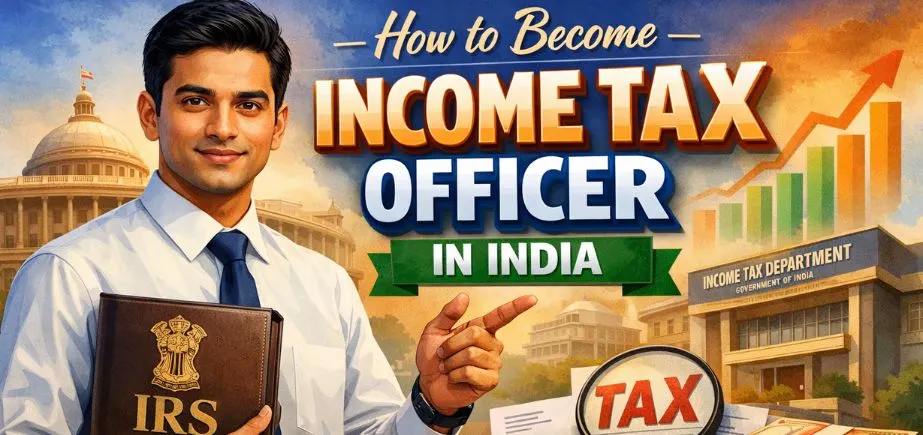
The job of Income Tax Officer is one of the most advantageous and esteemed jobs in the array of Indian government services. This is not only a job that will secure one with job security and good pay, but also with a chance to make a significant contribution to the economic structure of the nation. Being an Income Tax Officer is a profession that offers a combination of intellectual stimulation and societal contribution to students and young professionals who are interested in the field of taxation, finance, and public service.
In India, the Income Tax Department, which is a department of the Central Board of Direct Taxes (CBDT), is very important in terms of revenue generation and administration of taxes. The core of this system is the Income Tax Officers, who are the ones to ensure compliance with taxation, investigate fraud, and uphold the financial integrity of the system. This guide will take you through all you need to know about taking this dignified career, whether it is the requirements of the education or the examination preparation and skills development.
Knowledge of the Role: What is an Income Tax Officer?
The journey to becoming an Income Tax Officer is a journey that needs to be learned beforehand, of the depth and breadth of this job. An Income Tax Officer is a government professional whose duty is to enforce tax laws, carry out audits, and enforce the correct collection of the income tax in the country. These are the specialists who directly report to the Central Board of Direct Taxes (CBDT) and handle different tax-related issues that ensure that the revenue system of the nation runs well.
Essential Competencies and Roles
The profession of an Income Tax Officer has very diverse duties that involve technical skills as well as ethical standing. These specialists analyze tax returns of companies and individuals to make sure that the right tax rates are paid by companies and citizens. They carry out thorough tax evaluation in their day-to-day activities, and they examine financial records, check income statements, and make sure that there is accuracy in the calculation of taxes.
Enforcement and collection activities are considered one of the most acute sides of the job. Tax defaulters are those individuals or organizations that do not pay their taxes and are pursued by Income Tax Officers. This does not only entail financial savvy, but also good communication and negotiation, where officers have to deal with taxpayers most of the time to settle the pending dues.
Another important aspect of the work of an Income Tax Officer isinvestigation. Those professionals consider cases of tax evasion and fraud and find out complicated schemes created to avoid paying taxes. These probes can be done by analyzing complicated financial transactions, liaising with other departments, and making cases that can stand legal tests.
In addition to enforcement, Income Tax Officers are also involved withadministrative and service-related work. They also do tax audits to make sure that the regulations are not violated, receive tax refunds when taxpayers have paid more than they should, and help in tax planning programs. Also, they are critical in resolving tax-related conflicts between taxpayers and the department as mediators who have to strike a balance between regulations and justice to the citizens.
The surveillance aspect of the Income Tax Officers will make sure that there is always compliance with the tax law within their jurisdiction. They ensure that they are acquainted with the dynamic tax laws, they inform the taxpayers on their own duties, and they also adopt new policies as the government introduces them.
Continue to Read: How to Become Investment Banker After 12th
Educational Path: Laying the Foundation
Academic Qualifications
The career path to becoming an Income Tax Officer commences with a good level of education. The least qualification is a bachelor’s degree from a reputed university. Although the applicants are free to undertake their undergraduate programs in any stream, some have a more relevant education in this career.
Once you have finished your 10 + 2 education, there are a host of undergraduate courses that you can pursue. A Commerce (B.Com) degree is especially beneficial because it offers in-depth knowledge of accounting principles, financial management, and taxation of the business. Students studying a commerce degree have an opportunity to be exposed to areas such as financial accounting, cost accounting, corporate accounting, and taxation, and this is directly related to the practice of an Income Tax Officer.
Otherwise, law (LLB), economics, or accounting degrees are also a great preparation. A law degree provides an in-depth perspective on the legal structures and regulations adherence, which will be extremely useful in the interpretation of tax laws and dispute resolution. Economics degrees provide the development of appropriate analytical and fiscal policy insights and expertise, whereas reports on specific accounting studies create the technical skills of financial analysis and audit.
Amity Online University also has some specialized courses like the Professional Certificate in Corporate Tax Planning and Financial Analysis, which one can also take to gain specific knowledge of taxation and finance. Bachelor’s in Commerce and International Finance are also provided by them, which not only provides the students with theoretical knowledge but also relevant skills to work in the field of income tax administration.
Assessment of Age Requirements and Relaxations
The government has set certain age requirements for candidates who aspire to become Income Tax Officers. As a rule, candidates should be between18 and 30 years of age. Nevertheless, the government offers age relaxations to the applicants who are in reserved categories according to the rules.
They are relaxations whereby applicants are given more years of relaxation by the Scheduled Castes (SC), Scheduled Tribes (ST), Other Backward Classes (OBC), and persons with disabilities. Age relaxation is more or less category-specific and depends on current government policy, so one must refer to the official notification with each round of exams.
Read More: How to Start an Event Management Business
Examination Routes: Your Path to Success
In India, there are two main paths to becoming an Income Tax Officer, with each having its own examination system, level of difficulty, and career path. The knowledge of both directions will assist you in making a logical choice concerning the direction to follow and its suitability to your objectives and abilities.
Pathway 1: Staff Selection Commission – Combined Graduate Level (SSC CGL)
The easiest route to becoming an Income Tax Officer is by taking the SSC CGL examination, which will take one to the post of Inspector in the Income Tax Department. This test is an annual one, and it draws hundreds of thousands of applicants in India.
Tier I: Pre-Trial Examination
The initial level is called Tier I or Preliminary examination, and it is a computer-based test that has multiple-choice questions (MCQs) and objective-type questions. The test at this level examines your initial level of knowledge in a number of fields, such as General Intelligence and Reasoning, General Awareness, Quantitative Aptitude, and English Comprehension.
The preliminary test is a screening test, and the candidates are required to attain minimum qualifying marks to advance to the next level. The competition is tough, and lakhs of candidates are competing for a few positions; thus, proper preparation is imperative.
Tier II: Main Examination
On passing the Tier I examination, candidates proceed to Tier II, also known as the Mains examination. It is another computer-based stage that involves the use of several papers. In the papers, there are generally Quantitative Abilities, English Language and Comprehension, Statistics (in particular posts), and General Studies (Finance and Economics).
Mains examination is a higher level than the preliminary examination, and it demands deeper knowledge of the subject and improved time management skills. The questions are aimed at not only testing what you know but also how to implement concepts in real-life situations.
Tier III: Descriptive Examination
The third level is a drastic change compared to the two levels before it. It is a paper-based descriptive test that is aimed at testing your writing skills, your level of language proficiency, and your capacity to convey ideas in a clear and coherent way. Applicants are normally asked to write essays, a précis, letters, or applications.
This level examines your communication skills, which are essential skills of Income Tax Officers since he/she has to prepare reports, write assessment orders, and communicate with taxpayers. Good writing skills in English or the specified language are the key to success at this level.
Document Check and Medical Examination
Those who excel in all three levels are invited to document checking. At this step, authorities check your education qualifications, age documents, caste certificate (where necessary), and so on. Any anomaly or provision of forged papers may result in disqualification.
Shortlisted applicants are then subject to a medical fitness test after a successful verification of the documents. The health and physical test that is done on the candidates will determine whether an individual meets the physical and health requirements of the post. Only the ones who pass document inspection as well as the medical examination are appointed as Inspectors to work in the Income Tax Department in the last stage.
Pathway 2: Union Public Service Commission (UPSC)
Although no Income Tax Officer is directly recruited by the UPSC, passing the coveted UPSC Civil Services Examination can get one an appointment by the Indian Revenue Service (IRS), where you would initially be an Assistant Commissioner of Income Tax, which is a higher post than Inspector.
The UPSAT Examination Pattern
A significant number of people consider the UPSC Civil Services Examination to be one of the most difficult competitive exams in India. It comprises three separate phases, each of which is aimed at testing various facets of the knowledge and skills of an applicant, as well as his/her personality.
Preliminary Examination: The UPSC Prelims ensures two general papers: Paper I (General Studies) and Paper II (General Studies – CSAT or Civil Services Aptitude Examination). Paper I addresses current affairs, Indian history, geography, polity, economics, science and technology, as well as environmental ecology. Paper II is a test of comprehension, logical reasoning, analytical skill, and decision-making, as well as problem-solving. Although both papers are of objective-type, only Paper I counts are considered in the final ranking, but Paper II is qualifying in character.
Main Examination: Mains is a long-term written test, which consists of nine papers, and is administered over a series of days. It also contains two qualifying papers – an essay and one Indian language paper in the Eighth Schedule of the Constitution that examines your writing and language skills. There are also seven merit-ranking papers, among them four General Studies papers that cover a broad spectrum of subjects, such as ethics to international relations, and two elective subject papers to pick by the candidate depending on their strengths and interests.
The Mains examination not only involves knowledge but also requires the applicant to give coherent arguments, to examine issues from various perspectives, and to produce extensive answers within a limited time. The average time of preparation to take the UPSC Mains is 12-18 months.
Personality Test (Interview): Candidates who pass the Mains are invited to the last step, which is known as the Personality Test or Interview. This is done by a panel of top civil servants and professionals who examine your personality, communication ability, general awareness, capability to serve the state, and your thought clarity. The interview has a lot of weightage in the final selection.
Training and Allocation of Services
A merit list is drawn after the final results are announced, which is a combination of performance in the Mains and Interview. A candidate chooses the services that he or she considers most preferable first, and then the next. Applicants who choose the Indian Revenue Service (IRS) are given specialized training in the National Academy of Direct Taxes located in Nagpur and then are posted as Assistant Commissioners of Income Tax.
The UPSC pathway is more difficult but has increased career opportunities in the civil services system and may have a higher promotion in a career than the SSC one.
Know More: How to Make Money Online
Essential Skills for Success
In addition to academic qualifications and passing the examination, to be an effective Income Tax Officer, one needs to have a certain set of skills, which will enable you in your career.
Communication Excellence
Probably the most important skill an Income Tax Officer has is clear and concise communication. You should be capable of explaining complicated tax laws to taxpayers with limited financial backgrounds, producing comprehensive assessment reports that would hold up in legal court, and presenting your results to a high-ranking official and during a case in court.
The written and oral skills of communication are also crucial. Written communication will entail the preparation of notices, assessment orders, investigation reports, and official correspondence, which are required to be accurate, valid, and not ambiguous. Verbal communication is employed in the interaction with taxpayers, raids, investigations, and dispute resolutions when your ability to pose the right questions, negotiate successfully, and de-escalate stressful situations can be of great importance.
Attention to Detail
ITOs deal with huge volumes of financial information, complicated calculations, and complicated legal text. The one mistake, be it reviewing accounts, interpretation of a legal provision, or even computation of tax liability, can result in serious errors of both legal and financial nature.
The cultivation of attention to detail needs practice and discipline. In the process of preparing, develop such habits as reviewing your work twice, developing systematic review procedures, and being able to remain focused during long periods of time. These habits will not only help you in the exams, but also in your career.
Critical and Rational thinking
The law on taxes is not straightforward, and it is usually necessary to go through grey areas in the application and interpretation of a law based on the circumstances. To investigate financial statements, establish inconsistencies and trends that could lead to fraud or other legal issues, Income Tax Officers should have strong analytical skills.
Rational thinking assists in the development of consistent arguments, be it in the writing of an assessment order or a case before a superior authority. All these skills can only be developed through frequent training with case studies, problem-solving tasks, and keeping abreast with the current problems in taxation by means of newspapers, journals, and professional journals.
Dexterity and Continuous Learning
Tax laws in India are constantly revised by way of budget announcements, amendments, and new policies. It is the responsibility of the Income Tax Officers to keep up with such changes and swiftly update their knowledge and practices.
The development of the ability to change implies being okay with change, having a growth mindset, and lifelong learning. The tax journals should be subscribed to, the professional development programs should be attended, and the professional community should be involved in order to keep up with the knowledge.
Ethical Integrity
The power of the income tax officers is great, and the information they deal with is sensitive in nature. The post requires total moral integrity because officers should not be tempted to be corrupt, should keep confidentiality, and should treat all taxpayers equally in spite of their position and influence.
Developing a solid ethical base throughout your time as a student, such as making honest decisions, adhering to rules, and being ethical even with minor things, will give you the skills to handle ethical issues that will occur when you become an officer.
Technical Proficiency
Administration of tax is becoming more and more dependent on technology. The data analysis, tax evaluation, and record-keeping are done using a complex program by Income Tax Officers. Becoming comfortable with technology, knowing how to use the appropriate software programs, and how to work with digital financial transactions will provide you with an edge not only in the preparation of your exams but also in your future career.
Explore More: How to Start a Vending Machine Business
Preparation Strategy: Your Roadmap to Success
Both the SSC CGL and UPSC exams receive highly motivated candidates from all over India. Knowing the degree of competition and the level of rivalry would also assist in your preparation, taking due seriousness and planning.
Creating a Study Plan
To succeed in such competitive examinations, it must be a long-term process that is structured and consistent. The best place to start is the examination of the syllabus itself, the determination of your strengths and weaknesses, and the establishment of a realistic schedule that gives you enough time to cover each other.
Your study plan must be careful not to cover the complete syllabus, but learn the main concepts. Add periodic review periods, since learning as well as memorization is critical. Most successful applicants suggest you should concentrate on new content and spend 60-70% of your time on studying the new material and the last 30-40% on revision and practice.
Resource Selection
Select the materials for your study. The good preparation is based on standard textbooks on each subject, the previous year’s question papers, and other credible materials from coaching. In the case of SSC CGL, it is necessary to pay attention to the books about quantitative aptitude, logical thinking, English language, and general knowledge. In the case of UPSC, you will have to cover the enormous syllabus with NCERT books, standard reference books, and up-to-date sources of current affairs.
Do not fall into the trap of having too many resources. Take a small number of good books on any particular subject and read them carefully instead of browsing over a lot of material.
Mock Tests and Practice
Practising on a regular basis (by mock tests) is mandatory. Mock tests are used to serve various purposes: they show you the pattern of the examination, practice time management, determine the weak points where you need to pay more attention, and train your mental endurance to work under stress.
Practice taking the test early in the preparation stage. First, concentrate on the precision and not speed. You need to work slowly at increasing your speed with accuracy as you go. Study every mock test, not only how many questions you have gotten wrong, but why you have gotten them wrong, and how to prevent such a thing from happening in the future.
Current Affairs
The current affairs and general awareness are both emphasized in both SSC CGL and UPSC. Read newspapers on a daily basis. Hindu, Indian Express, or any other credible national dailies are supposed to be included in your daily routine. Also, subscribe to monthly current affairs magazines that summarize significant news, government schemes, international news, and economic information.
On taxation-particularly current affairs, refer to budget announcements, significant tax policy reforms, and landmark legal decisions as far as taxation is concerned. These shall be especially applicable to your profession, and they might be found in exams.
Balancing Breadth and Depth
Particularly among those who are attempting to pass exams in UPSC, it is difficult, but essential to find the right balance between the scope of the knowledge and the depth of knowledge. The material that should be covered is enormous, and the problems are frequently met with in-depth knowledge instead of shallow knowledge. Learn ideas, how these ideas relate, and how the ideas are applied in real life, as opposed to memorizing facts.
Additional Certifications and Career Enhancement
Although the minimum academic qualification to work as an Income Tax Officer is a bachelor’s degree and passing the competitive examination, other forms of certifications can enhance your knowledge, performance in the examination, and help improve your career development.
Taxation, accounting, or financial certification is an indication that you are committed to developing professionally. You may want to take up a degree in taxation, GST, international taxation, or an analysis of finances. Not only do they enhance your knowledge, but they also enable you to be more efficient in your job.
Such professional qualifications as CA (Chartered Accountancy), CMA (Cost and Management Accountancy), or CS (Company secretary) equip one with a complete knowledge of accounting, auditing, and corporate laws- all of which are very relevant in income tax administration. Though they are time-consuming qualifications, most Income Tax Office holders do them as they continue their careers to improve their skills and career opportunities.
Life as an Income Tax Officer: What to Expect
Knowledge of what to expect upon passing the examination is beneficial for making a good career choice and psychological preparation for the difficulties and expectations beforehand.
Career Progression
There are clear career advancement opportunities with frequent promotions to the Income Tax Officers, depending on experience and performance. Officers can become Commissioners and Chief Commissioners throughout their careers, starting as an Inspector (through SSC) or Assistant Commissioner (through UPSC).
The department provides a chance to specialize in such fields as investigation, international taxation, or formulation of tax policy. Others (some of the officers) are also provided with chances to be assigned to work in other government departments, represent India in international forums, or even make policies at the top tiers.
Job Security and Benefits
Being government employees, Income Tax Officers have great job security, frequent salary increases, and perks such as healthcare, accommodation, and pension. The salaries are also competitive and updated on a frequent basis according to the recommendations of the Pay Commission.
In addition to financial reward, the job has non-financial rewards such as social status, a chance to serve the country, and the self-reward of being able to work to better the public with effective administration of taxes.
Challenges and Rewards
This is not a job without challenges. The job of ITO is usually demanding, taxpayers may be aggressive or uncooperative, and they have to deal with ethical issues. This may mentally be taxing, and one has to be on her guard all the time and make decisions that have far-reaching effects.
But we have rewards, both tangible and intangible, which render the hassles worth it. Professional fulfillment is great, as the chance to maintain fiscal integrity, contribute to nation-building, and have a valued career in serving the people gives great professional satisfaction.
Conclusion
The process of becoming an Income Tax Officer is a challenge to your academic skills, endurance, and service to the nation. It needs special preparation, building of pertinent skills, and a real interest in the field of taxation and finance.
The road can be a difficult one, with the serious rivalry and rigorous tests, but the reward, a good, well-paid, and valuable career in government service, is the reward of the journey. You will find that no matter the route (SSC CGL) you decide to take to be directly recruited as an Inspector or the harder route (UPSC) to the Indian Revenue Service, it takes hard work, planning, and perseverance.
Begin by enhancing your educational background by undertaking pertinent undergraduate courses. Other courses, such as commerce, taxation, and finance, can be considered as special courses offered by institutions such as Amity Online University. Perfect the key skills such as communication, analytical, attention to detail, and ethical, which will benefit you in the future. Establish a systematic preparation plan, follow it rigorously, and be motivated by the challenges that are bound to come.
It is worth bearing in mind that it is not only that you pass an examination when you become an Income Tax Officer, but that you get ready to join a profession where you will be able to contribute a lot to the economy of the country. Your contribution will assist in ensuring compliance with taxes, fighting fraud, and improving the capacity of the government to finance its services to the people and development projects.
Throughout this process, keep track of the pattern of examinations, changes in policies, and career opportunities. Get in touch with effective officers, mentors, and never give up on your objective despite the challenges. Anyone can realize his or her dream of becoming an Income Tax Officer and taking a fulfilling career in the service of the country with the right attitude, preparation, and hard work.
The Indian taxation system requires quality, professional, and committed employees in order to make the system effective and ethical. You are not only locking in your future when you pursue this career; you are also taking a step forward into a career where you can really have an impact on the economic well-being and financial situation of your country. Make a beginning today and start your steps to this great and noble profession.