

The modern fulfillment facilities are under increasing pressure due to the growing customer demands, worker shortage and the accelerating rate of ecommerce development. Warehouse automation tools have become the key solution, changing the way business is handled in managing inventory, order fulfillment and competitive advantage. These technologies are a combination of physical robotics and smart software systems to develop flawless operations that allow machines and humans to work together.
Through proper warehouse automation tool applied in a warehouse, the company will be able to cut down on the working costs tremendously, cut down the number of mistakes made and expand its operation without having to proportional rise in the number of people who have to be employed.
What Is Warehouse Automation?
Warehouse automation is a strategic use of technology systems that minimize or do away with the involvement of manual operations in the fulfillment processes. These solutions go as far as a high-end autonomous robots and artificial intelligence-driven software, which coordinates whole facilities, as simple as a barcode scanner and conveyor belt.
The essence is to redesign the monotonous, manual-driven operations in warehouses to achieve smoother operations resulting in increased precision, enhanced speed and efficiency of resources. The current-day warehouse automation systems form an interdependent ecosystem with the information flowing freely between the hardware and software and used to make decisions in real-time and optimize constantly.
Key Components
- Physical Robotics: Movement of goods and items Self-directed robots that move around and provide support to employees in facilities.
- Control Software: Management systems which plan the activities of robot fleets, humans, and material handling equipment at the same time.
- Sensor Networks: Vision cameras and trackers which can give real time location information and environmental knowledge.
- Information Integration: APIs and middleware between automation equipment and available enterprise resource planning systems.
- Human Interface: Workstations and mobile devices on which the operators will be interacting with the automated systems and dealing with exceptions.
Types of Warehouse Management Systems (WMS) & Their Role in Automation
- Cloud-Native Platforms: The current SaaS platforms, which have real-time visibility, quick deployment and smooth robotics integration capabilities.
- On-Premise Systems: Traditional systems include all the controls of data and complete customization to complex warehouse operations.
- Hybrid Solutions: Hybridized Solutions A combination of local control needs and cloud-based analytics and remote management capabilities.
- Niche WMS: Industry-oriented WMS systems that are tailored to industry needs such as cold storage, hazardous materials or controlled products.
- Execution Systems: Lightweight systems which concentrate on task coordination and real-time coordination between automation and workers.
Benefits of Warehouse Automation
- Corrected Accuracy: Automated systems minimize picking errors of 1-3 to 0.1 and this considerably decreases returns and rework.
- Optimization of labor: Workers are doing the complicated exception management whereas machines are dealing with the repetitive tasks in transport and retrieval.
- Space Efficiency: (Dense storage) and vertical utilization plans optimize the space available on available building footprints.
- Scalability: Operations can be scaled either up and down without proportional changes in workforce to meet seasonal demand variation.
- Cost Reduction: Reduced operational costs based on fewer errors, better labour deployment and better inventory turnover rates.
Top 10 Warehouse Automation Tools (2026 Edition)
1. Fishbowl Inventory
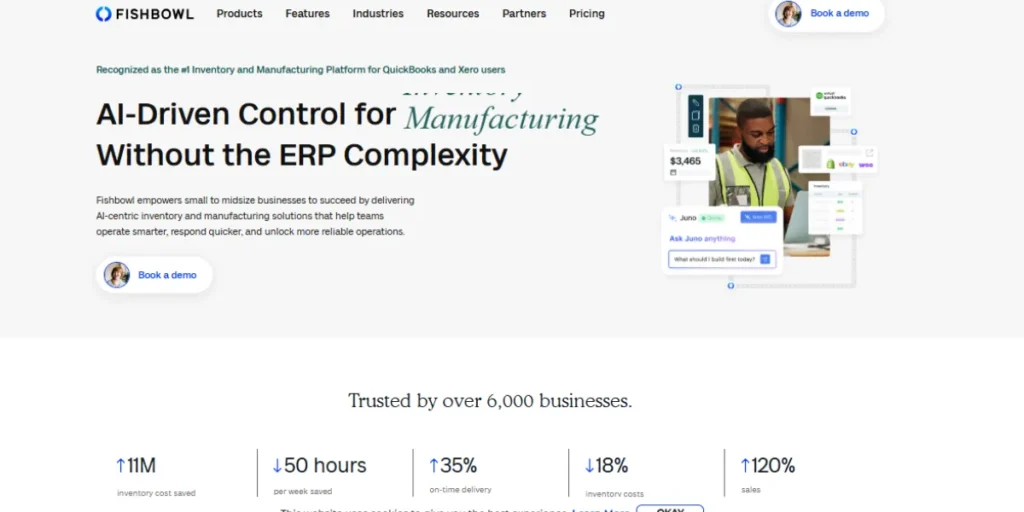
Fishbowl Inventory is complete warehouse automation devices of small to mid-sized businesses and the one that requires inventory management with manufacturing integration. This platform is a desktop and cloud based application that automates inventory, order and warehouse operations in addition to integrating with QuickBooks to synchronize all financial records. Fishbowl allows the barcode scanning during both receiving, picking and shipping operations, which removes data entry errors that are common in the scaling up operations.
The software links multiple warehouses and automatically records lot and serial numbers and provides real-time reports of the level of stock and the movement pattern. In case a company is moving off spreadsheets and to a more appropriate warehouse automation tool, Fishbowl offers an easy to use yet high-performance solution that can handle an increase in operational complexity.
Key Features:
- Barcode scanning inventory tracker mechanism.
- Distributed warehouse and inventory relocation.
- Orders management that automates pick, pack and ship processes.
- QuickBooks synchronization between inventory and financial data.
- Production and materials planning manufacturing module.
Pricing: Essentials $199 USD/mo; Growth $399 USD/mo; Scale $699 USD/mo; Custom
Best For: Small manufacturers
Link: https://www.fishbowlinventory.com/
2. Zebra Savanna Data Intelligence Platform

Zebra Savanna Data Intelligence Platform is the next level of warehouse automation tool that convert raw data of operations into actionable data utilizing cloud-based analytics. This platform is a compilation of information that is captured by barcode scanners, mobile computers, RFID readers, and sensors within the facilities and then uses artificial intelligence to recognize patterns and optimization possibilities.
The visibility solutions offered by Savanna help monitor assets, inventory and workers in real-time in order to be able to make decisions proactively before problems affect operations. The platform is also compatible with multiple warehouse management systems and enterprise applications, which have integrated into single data environments where warehouse automation services can exchange information flawlessly. To the operations aiming to use data as a competitive edge, Savanna offers the analytical basis upon which information is transformed into operational excellence.
Key Features:
- On-the-fly asset and inventory tracking between facilities.
- Machine-learning-based analytics finding areas of optimization.
- Connection with scanners, mobile devices and RFID system.
- Minimal IT infrastructure cloud-based architecture demanded.
- Prescriptive intelligence proposing particular action to be taken.
Pricing: custom quote
Best For: Data-driven operations
Link: https://investors.zebra.com/overview/default.aspx
3. NetSuite WMS
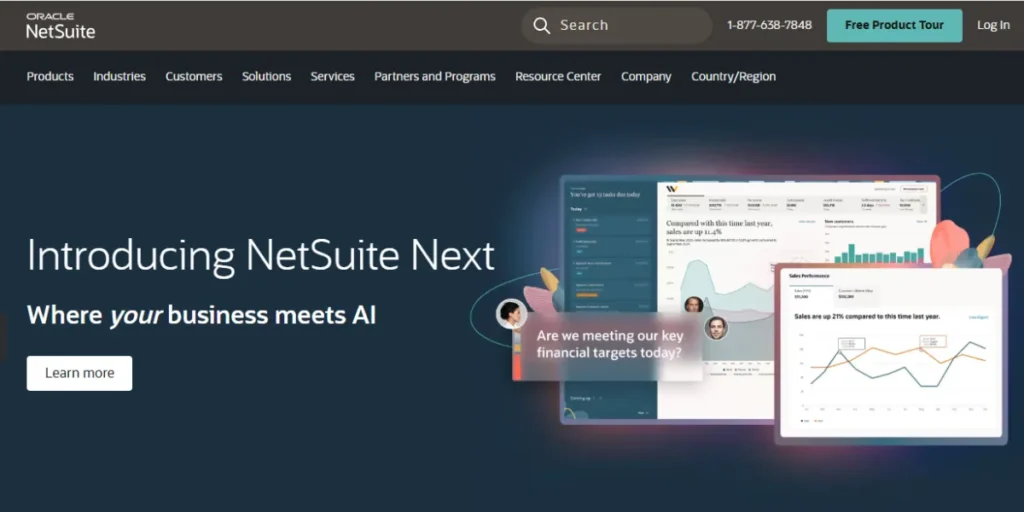
NetSuite WMS provides cloud-based warehouse automation tools, available as a part of the NetSuite ERP platform, and enables business data to move freely throughout all business processes. It is a warehouse management system that employs mobile devices and barcode scanning to instruct the workers to follow an optimal receiving, putaway, picking and shipping procedure.
NetSuite WMS uses intelligent algorithms to manage the bins and wave planning, which is used to make sure that inventory placement and retrieval plans are as efficient as possible, at all times. The visibility of the platform is real-time throughout the whole supply chain, purchase orders to the delivery of the product to the customers, which promotes the coordination of the decisions. To businesses that are already using NetSuite or one that needs unified business system, the WMS can remove the integration issue and provide advanced warehouse automation capabilities.
Key Features:
- Picking tasks within the warehouse that are led by a mobile phone.
- Smart bin management to enhance the use of storage space.
- Optimization of the productivity of wave planning and batch picking.
- Inbuilt interconnection with ecommerce modules and NetSuite ERP.
- Real-time stock accuracy at all business systems.
Pricing: between $1,000 and $2,000 per month
Best For: NetSuite users
Link: https://www.netsuite.com/
4. Sortly Pro
Sortly Pro offers graphical warehouse automation software that appeals to companies that value simplicity and these tools being accessible, through a mobile device, when managing inventory. It is a cloud-based application that can be used to generate a visual inventory catalog through smartphone cameras, which include photos and QR codes, and customizable tags. Sortly will automate stock management with workflow scanning, automatic low-stock notifications, and inventory value reporting and movement.
Though simpler than enterprise warehouse automation solutions, Sortly has the advantage of introducing organization and automation to smaller organizations or a particular inventory type. The user-friendly interface of the platform does not need much training, and a platform can be adopted quickly by teams. And in the case of companies that require simple warehouse automation systems and do not have the resources to implement it extensively, Sortly offers businesses convenient features with a mobile-first nature.
Key Features:
- Photos and custom labels Visual inventory management.
- Creation of QR codes and scanning of fast updates.
- Computerized low-stock warnings and reordering.
- Applications that would allow management of inventory anywhere.
- Collaboration with customizable access permissions among many users.
Pricing: Free; Advanced $24 USD/mo; Ultra $74 USD/mo; Premium $149 USD/mo; Get a Quote
Best For: Visual inventory tracking
Link: https://www.sortly.com/
5. Deposco Bright Warehouse

Deposco Bright Warehouse integrates warehouse and inventory management as one warehouse automation tool tailored to the operations of omnichannel commerce. It is a cloud-native platform that coordinates fulfillment through channels and locations to achieve real-time inventory visibility and prevent overselling and stockouts. The Bright Warehouse applies smart order routing algorithms that decide the best places to fulfill the order depending on the availability of the inventory, shipping expenses, and the delivery schedule.
The system integrates pick, pack, and ship operations using mobile devices and ensures accuracy by means of the barcode validation at each stage. Deposco also provides retailers and brands with complex omnichannel fulfillment with warehouse automation solutions balancing both efficiency and customer experience needs.
Key Features:
- Inventory transparency in all sales outlets.
- Smart order routing that is smart about the fulfillment decisions.
- Barcode checking and mobile-guided working processes.
- Accurate real time synchronization to prevent overselling.
- Connection with leading ecommerce systems and platforms.
Pricing: custom quote-based service
Best For: Omnichannel fulfillment
Link: https://deposco.com/solutions/supply-chain-execution/warehouse-management/
6. inFlow Inventory

inFlow Inventory provides affordable warehouse automation softwares to small and growing businesses that need inventory management without enterprise features and expenses. This desktop and cloud based software automates the order processing, stock tracking in the various locations and automatically generates purchase orders when the inventory hits its reorder point during the receiving, picking and cycle counting processes, and it also has the ability to scan barcodes as the data is entered manually, while integrating smoothly with project management tools to support better workflow coordination.
The site comes with inherent inventory value reporting, sales trends, and inventory movement, which are used in the purchasing and operations decisions. InFlow is a small company that is moving out of spreadsheets or wants to automate their warehouse at a lower cost because they offer the necessary features with simple implementation.
Key Features:
- Auto reorder point notifications and purchase order development.
- Warehouse transactions optimization through barcode scanning.
- Multi-location inventory tracking and transfers.
- Pick list generation Sales order management.
- Inventory reporting with values, trends and movement.
Pricing: Entrepreneur $129 per mo, Small Business $349 per mo, Mid-Size $699 per mo, Enterprise custom
Best For: Growing businesses
Link: https://www.inflowinventory.com/
7. Cin7 Omni

Cin7 Omni provides a whole warehouse automation tools which links the inventory management with the sales channel, warehouse and accounting system in real time. This cloud solution automatically processes orders received through various points of sale, ships to a respective warehouse and synchronizes inventory across all the systems in real time.
The strengths of Cin7 are that it provides automated demand forecasting, intelligent calculation of the reorder points and production planning to businesses whose operations involve manufacturing. The system integrates third-party logistics operations with owned warehouses, and this generates single visibility irrespective of the location of inventory. Various channels and locations in which product businesses operate to manage their complex operations is where the warehouse automation tool offered by Cin7 are useful to completely eradicate data silos and manual processes, while also supporting dropshipping management tools for smoother order fulfillment.
Key Features:
- Inventory synchronization across all the sales mediums.
- Demand forecasting is automated and reorders are calculated through intelligence.
- 3PL co-ordinating third party warehouse.
- Bill of materials management and production planning.
- Premium integrations with large ecommerce and accounting systems.
Pricing: Standard $349/month, Pro $599/month, Advanced $999/month, Omni custom
Best For: Multi-channel businesses
Link: https://www.cin7.com/solutions/omni/
8. RF-SMART
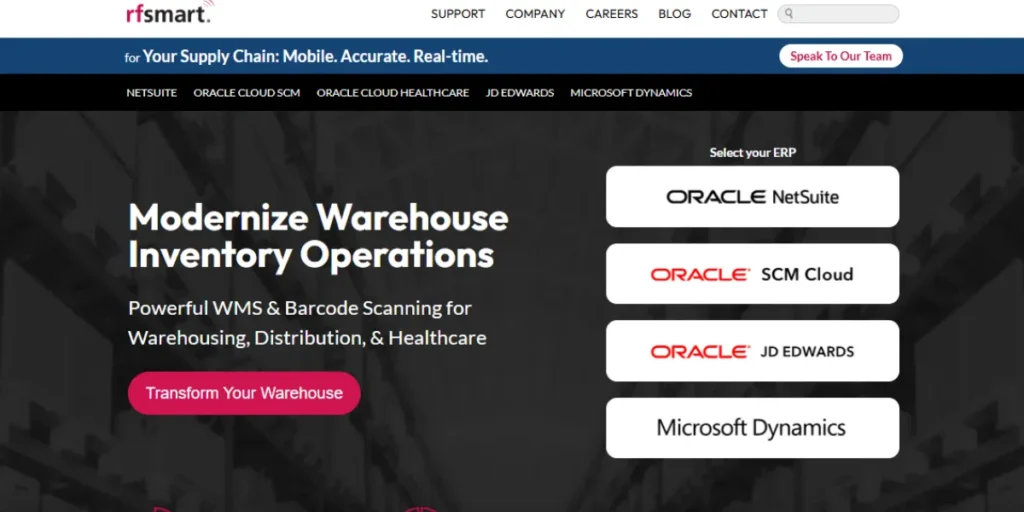
RF-SMART offers mobile warehouse automation devices that will add enhanced warehouse management features to NetSuite and Acumatica ERP systems. The solution can turn ordinary mobile gadgets into powerful data collection tools in directing workers in the warehouse through streamlined work processes. RF-SMART provides automated directed putaway, wave picking, cycle counting and shipping verification with real-time synchronization with underlying ERP systems.
This platform has the flexibility of enabling businesses to design workflows that fit their unique operation needs without having to write code. RF-SMART is available to companies that leverage NetSuite or Acumatica with the aim to expand the capabilities of warehouse automation softwares to provide a mobile-first experience, allowing them to enhance accuracy and productivity rates to a large extent.
Key Features:
- All warehouse processes have to be directed over mobile.
- ERP integration in real-time, keeping the data in line.
- Adjustable screens that accommodate business processes.
- RFID and barcodes scanning of precise data collection.
- Automation of lot, serial, as well as expiration date tracking.
Pricing: custom pricing
Best For: NetSuite/Acumatica users
Link: https://www.rfsmart.com/
9. ShipBob WMS

ShipBob WBS provides cloud-based warehouse automation equipment to brands that have their fulfillment network with ShipBob or those brands with their own distribution facilities. This platform will give real-time visibility of inventory, automate the order routing and fulfillment flows, and generate analytics on warehouse performance metrics. ShipBob WMS manages the process of receiving, quality control, putaway, picking, packing, and shipping using mobile-guided workflows that reduce the number of errors.
It is directly connected to the large ecommerce sites, which automatically draw orders and update the tracking data of all sale channels. ShipBob presents custom-built features with no legacy complexity to direct-to-consumer brands in need of warehouse automation solutions to fit the workflow of modern ecommerce.
Key Features:
- DTC-friendly ecommerce design.
- Computerized routing of orders in various warehouses.
- Spot on mobile-guided workflow of all operations in the warehouse.
- Inventory synchronization in sales channels in real-time.
- Accuracy, speed and costs of performance analytics tracking.
Pricing: Contact for pricing
Best For: DTC brands
Link: https://www.shipbob.com/wms/
10. Extensiv Warehouse Manager

Extensiv Warehouse Manager is an enterprise-specific transportation of cloud-based warehouse automation devices that are oriented to third-party logistics providers and brands that run numerous fulfillment centers. This platform coordinates complicated work with many clients and facilities, keeping the inventory and a billing record of each single client and optimizing working efficiency.
Extensiv works automatically as it provides receiving, quality control, kitting, picking, packing, and shipping service which are customizable workflows to work with various client needs. The billing engine of the system automatically calculates the charges, which are based on transactions, storage, and special services, which simplifies the invoicing of the 3PL operations. To those logistics providers who need warehouse automation tools, which is able to manage the multi-client complexity, Extensiv offers an enterprise-level solution with the ability to deploy it easily via the cloud.
Key Features:
- Multi-customer warehouse management with individual inventory tracking.
- Billing engine that is automated and calculates charges based on the transaction.
- Workflow that could be configured to meet various client needs.
- EDI integration serving retail and wholesale customers.
- KPI performance dashboards at the facility and client level.
Pricing: custom pricing
Best For: Third-party logistics
Link: https://www.extensiv.com/extensiv-warehouse-manager
Challenges & Considerations When Automating the Warehouse
- Complexity of Integration: Any efforts to integrate the warehouse automation tool, with the old systems, need a lot of planning and technical understanding.
- Change Management: When automation affects the way work is done by altering operational roles, workers should be trained and assured that they will have a role to play.
- Capital Requirements: It can be expensive to invest in the short term with upcoming high ROI and the financial planning and justification is necessary.
- Facility Constraints: Considering the layout of the existing buildings, some adjustments could be necessary to install automated equipment and an efficient flow of the materials.
- Technology Choice: The decision between rival automation methods requires in depth examination of the operational needs and scalability in the future.
How to Select the Right Automation Tools
- Process Mapping: Records the existing processes that have bottlenecks, sources of errors and processes that use a lot of labor that have to be automated.
- ROI Calculation: Measure anticipated savings on less error, labor optimization and space efficiency against the implementation costs.
- Scalability Assessment: Determine the ability of warehouse automation to expand with business volumes, and to meet the varying needs.
- Vendor Evaluation: Before committing to solutions, research providers have to be stable and have to be supportive, integrate and have to have customer references.
- Gradual Adoption: Initially pursue targeted pilot projects who can prove worthiness before automating an entire facility.
Conclusion & Recommendations
The scenery of warehouse automation software has evolved to reach a great extent and has provided solutions to operations of all sizes and complex levels of operation. To be successful, automation must be treated as a strategic change which will affect processes, people, and systems across the supply chain. The first step in the process that companies should undertake would be to carefully evaluate current operations to know certain areas of pain where warehouse automation can provide quantifiable results.
Instead of automating, invest in those areas where technology can really contribute to solving business issues perhaps inaccuracy, labour, space or throughput bottleneck issues. The most robust integrations involve physical robotics and intelligent software platforms, which form an ecosystem in which machines are used to repeat actions and people, exceptions, and constant improvement.
FAQs
What are the primary forms of warehouse automation tools?
Robotics-based orchestration systems and cloud-based inventory management software, WMS, mobile scanning applications, and inventory management software.
What is the average cost of the warehouse automation devices?
Subscribing to software is between $29 every month to thousands of dollars on enterprise software.
Are small warehouses able to benefit through automation?
Yes, there are inventory management systems in the clouds and mobile scanner applications that are low-cost automation to smaller operations.
What is the duration of implementation of warehouse automation?
Cloud software takes days-weeks to deploy and enterprise WMS takes several months of full deployment.