
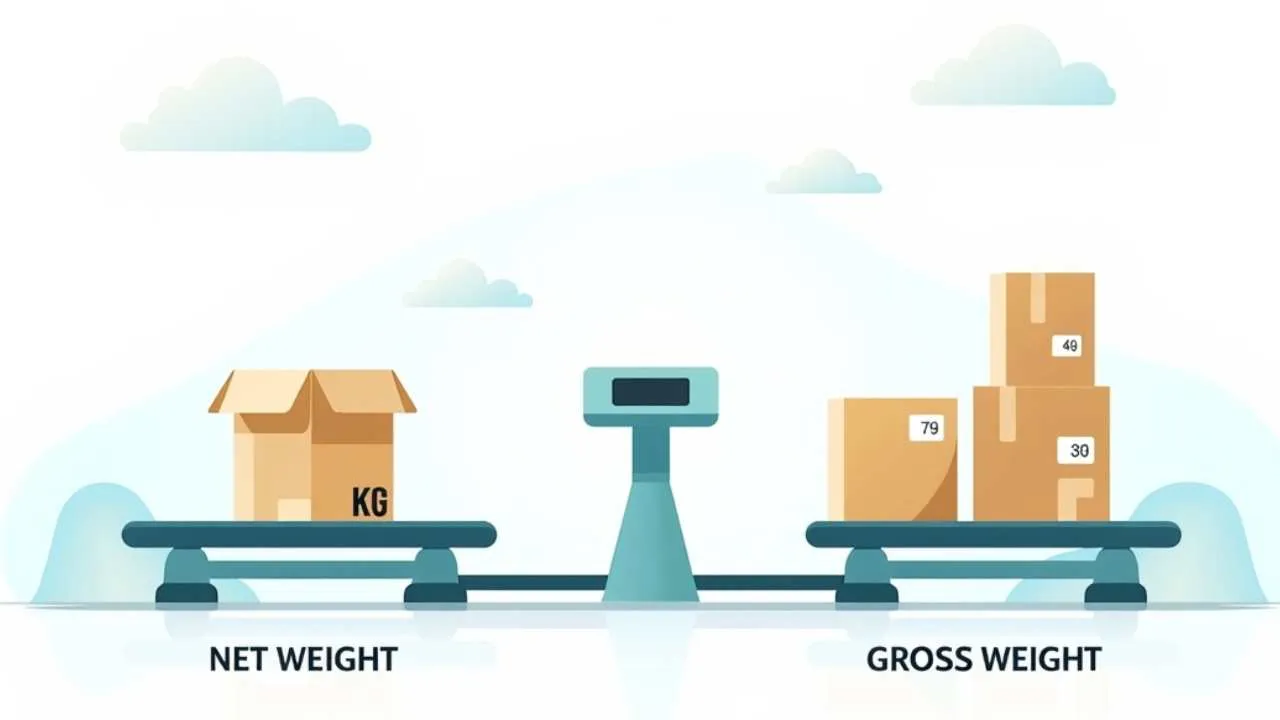
When you take a product off the shelf of a store or when you are putting together a shipping container for your company, you will see two weight measurements: Net Weight and Gross Weight. These terms may appear to be alike or even bewildering merely at a glance, but the explanation of the difference between these two concepts is vital to both consumers, business organizations, and logistics practitioners.
As a shopper working to ensure you are getting the best price in your money, as a manufacturer working on the cost of production, or a shipping manager working on the cost of freight, knowing the difference between Net Weight vs Gross Weight can prevent some costly mistakes, regulatory fines, and inefficient ways of doing business. This is a complete bible that simplifies all you need to know about these two basic weight measures in an easy-to-understand, practical way.
Why Net Weight and Gross Weight Matter in Real-World Applications
Knowing what is the difference between Net Weight vs Gross Weight has a great practical value in many situations:
- Cost Savings: The cost incurred by shipping companies is calculated in gross weight, and thus knowing the actual figures will help you avoid spending more money on purchasing a package that is not necessary.
- Regulatory Compliance: Government bodies demand proper weight declarations in order to guarantee the safety of the roads and just taxation of the transported goods.
- Consumer Protection: The food labeling laws require showing the net weight clearly so that customers are aware of the exact amount of the product they are buying.
- Inventory Control: Raw materials are monitored in terms of net weight by manufacturers so that production efficiency is calculated precisely.
- Safety Standards: Overweight vehicles are dangerous; knowing gross weight will avoid accidents and equipment destruction.
- International Trade: The amount of duties paid on international trade depends on the net weight, and there is a need to make proper measurements to engage in cross-border trade.
What Is Net Weight? (Definition, Meaning & Examples)
Net weight is the weight of the actual good itself, with no reference to the packaging, the containers, or other materials. It is just a commodity or goods that you are selling, buying, or transporting. In the case of consumers, net weight lets you know the precise amount of usable product you get for the money. Packaging laws in the food industry necessitate that manufacturers put the net weight on the packaging labels in bold fonts.
Examples: when you buy a bottle of olive oil, you only buy the oil in it- not the glass bottle, the top or the label. Net weight in shipping terms refers to the cargo or the payload itself, on which the customs officers base their duty and tax of international freight.
What Is Gross Weight? (Definition, Meaning & Examples)
Gross weight refers to the weight of the entire product, consisting of the item to be transported and all the wrappings including packaging bags, boxes, pallets, and wrapping materials. This is the entire weight which has to be undertaken, lifted or carried. Gross weight is applied in the logistics field in the determination of freight rates, the limitations of loading the vehicle, and equipment needs.
Example: when they ship out that bottle of olive oil in a cardboard box with bubble wrap on a wooden pallet, the gross weight would be that of the oil, bottle, box, wrapping materials, and pallet. Gross weight is used by transportation companies to estimate the fuel usage, to identify the right capacity of a vehicle, and to obey the road limits on weight. The gross weight is also needed to ensure safe loading and effective planning of logistics.
Net Weight vs Gross Weight: Key Differences Explained
The nature of the difference between Net Weight vs Gross weight is easy to grasp, the former weighs of the product alone, the latter weighs of the product plus all that comes with it. The gross weight will never be less in comparison to the net weight since it has other packaging materials.
| Aspect | Net Weight | Gross Weight |
| Definition | Weight of product alone | Total weight including packaging |
| Includes Packaging | No | Yes |
| Includes Containers | No | Yes |
| Used By | Consumers, customs, manufacturers | Logistics, transporters, freight companies |
| Label Requirement | Mandatory on food products | Typically for shipping documents only |
| Purpose | Shows actual product quantity | Shows total weight to be transported |
| Affects | Product pricing, taxes, duties | Shipping costs, fuel, handling fees |
| Which Is Larger | Always smaller | Always larger |
Net Weight vs Gross Weight Formula (With Practical Examples)
The Net weight vs Gross weight calculations are simple mathematical equations that any individual can solve.
Gross Weight = Net weight + Tare weight (weight of empty packaging) = Gross weight Formula.
On the contrary, Net weight Formula is: Net weight = Gross weight – Tare weight.
Example: Shipping machine parts in a wooden box. To start with, empty case weight: weighing the empty case, it weighs 50kg (tare weight). Then parts are loaded and everything is weighed and it gets 550 kg (gross weight). When you minus the tare with the gross, you get 500 kg- your net weight, the weight of parts themselves.
How to Calculate Net Weight Easily (Net Weight Calculator Guide)
It is always accurate to calculate net weight systematically when it applies to several shipments or inventory items. Measurements are to be made with the following steps:
Step 1: 10kg Case empty weight: Use this step to weigh an empty package (box, crate, drum, or pallet) on a calibrated scale. Note down this as your tare weight. On standardized containers, the manufactures usually have the tare weight printed directly onto the container and this saves you this step.
Step 2: Fill the Packaged Product: Take the finished product and weigh it all. It is your gross weight. Make sure that your scale is well calibrated and able to hold the entire load.
Step 3: Subtract to Determine the Net Weight: Just subtract the tare weight with the gross weight. The outcome is your net weight, that is, the weight of your product itself.
Practical Example:a steel drum has a weight of 25 kg when it is not loaded. It is filled with 175 kg of chemical powder. The loaded drum is 200kg on the scale. Accordingly: Net Weight = 200 kg (gross) -25kg (tare) = 175kg.
Tare functions on digital scales can be used by many businesses to automatically deduct the weight of containers, simplifying this process when dealing with high-volume business.
Does Net Weight Include Packaging or Containers?
The response is resolutely no; the packaging and containers are never counted as the net weight. This forms a very essential point of difference in knowing Net Weight vs Gross Weight. Net weight will only reflect the consumable or usable product within. Both food products in jars and chemicals in drums, as well as parts in crates, the net weight computation eliminates all but the goods.
Example: when you buy a 5-liter can of paint, the net weight will be that of the paint, and not the metal can, the lid, or the handle. This is the universal rule when it comes to industries. The weight of the packaging is also referred to as tare weight and is never counted in net weight. This makes consumers aware of the quantity of product they are buying, and businesses can correctly estimate their material costs and customs duties.
Net Weight Units and Conversions (kg, grams, lbs & more)
The world is weighing differently as most countries have adopted the metric system of weight measurement, whereas some countries, such as the United States, have employed the imperial units. International trade and shipping would not be possible without the knowledge of the conversions between these systems.
Common Metric Units:
- Milligrams (mg) – for tiny quantities
- Grams (g) – for lightweight items
- Kilograms (kg) – standard unit for most products
- Metric tonnes (t) – for large shipments (1,000 kg)
Common Imperial Units:
- Ounces (oz) – for small items
- Pounds (lbs) – standard U.S. unit
- U.S. tons – for heavy freight (2,000 lbs)
Essential Conversions:
- 1 kg = 2.204 lbs
- 1 lb = 0.453 kg
- 1 metric tonne = 1,000 kg = 2,204 lbs
- 1 U.S. ton = 907 kg
- 1 oz = 28.35 g
Important Note: Always verify whether “ton” refers to a U.S. ton (2,000 lbs) or metric tonne (1,000 kg). This 93 kg difference can lead to significant errors in large shipments.
Which Is Bigger: Net Weight or Gross Weight?
The gross weight will never be less than the net weight- this is an unalterable law in weight measurement. The reason is this, all products will need some packaging, container or protective medium to handle, store or transport. Gross weight should be bigger since it is the product of (net weight): the product of (net weight) plus all the packaging materials (tare weight).
The slightest packaging, such as a plastic bag or a cardboard sleeve, increases the weight. In unrealistic theoretical scenarios in which a product is fully packaged in zero packaging and thus is measured entirely naked, the net and gross weights may be equal, although this is never practically the case in real-life business or transport. In the comparison of Net Weight vs Gross weight, this relation is basic in its understanding.
Example: you have a shipment of 800 kg of coffee beans, which has a net weight of 800 kg but which has a gross weight of 875 kg when you factor in the bags, boxes, and the pallet.
Common Industry Use Cases of Net and Gross Weight
The Net Weight vs Gross Weight is most preferred in different industries depending on their operations:
- Food and Beverage Industry: Concentrates on net weight as a label to the consumer and standards to be met; their consumers need to be aware of the exact amount of the edible product they are buying.
- Logistics and Freight: It is based on gross weight in terms of calculating the price of shipping, the fuel needs, and the fact that the vehicles are not overweight.
- Manufacturing: Needs a net weight to monitor the consumption of raw materials, the production yields, and the costs of inventory, which can be effectively managed.
- Pharmaceuticals: Focuses on net weight, which is used to determine exact dosing needs and measurements of active ingredients, and gross weight is used to monitor shipments.
- Chemicals & Hazardous Materials: Includes both the measurements, net weight of safety data sheets, handling procedures, and gross weight of transportation regulations.
- E-commerce & Retail: Strikes a balance between both weights, where net is the balance of the product descriptions and pricing, whereas the gross is the balance of the shipping costs and selection of carriers.
Conclusion
Knowing the difference between Net Weight vs Gross Weight is not simply the act of going through and understanding two definitions; it is the act of making informed choices that affect your finances, operations, and compliance. On the part of consumers, this knowledge is used to guard against deceptive packaging methods and to ensure a fair value.
To companies, it streamlines shipping costs, regulatory violations, and raises the accuracy of inventory. The equations are easy- add weights and subtract to get gross and net, but their uses are mighty. You need to know Net Weight vs Gross Weight in order to create a successful shipment. Whether it is a shipment of frozen meat or a consignment of cereal boxes at the supermarket, you will know to make the right decision. The next time you encounter these numbers on a label or a shipping document, you will know precisely what these numbers are and what their significance is!
FAQs
1. Is it possible that Net Weight and Gross Weight are the same?
Yes, technically, but in the event that no packaging is applied at all. In a practical shipping and trading environment, the gross weight is very nearly larger since the products must come in some form of reach or protection wrapping.
2. Are shipping companies charged on Net or Gross weight?
The shipping rates are based on the gross weight (or the dimensional weight of large, lightweight packages). Carriers are supposed to carry the whole package not only the product itself hence they charge based on the total weight.
3. What is the Tare weight of a container?
In the case of the standardized shipping containers and drums, tare weight would be commonly stamped or printed on the door or side of the container. In the case of custom packaging, weigh the empty container then load to ascertain tare weight.
4. What is the reason why Net Weight information is needed on customs?
Due to packaging, customs duties, import tax, etc are calculated on the basis of the actual weight of the product (net), not the packaging material. This guarantees that there is fair taxation of goods as opposed to transportation materials.
5. What would happen in case I take the wrong weights during shipping?
Wrong weight statements may attract extra charges, delays in shipments, repudiation, or custom sanctions. In the context of road transport, overweight is a serious problem in terms of safety and legal aspects.