

Do you ever think that old banks are slow? You must stand in long queues, fill plenty of paper forms, and their applications may be difficult to use. Well, things are changing! A different kind of bank is in town and it is directly on your smart phone. They are called Neo Banks in India.These new banks are getting loved by India. In 2024, the neo bank market in India had a value to the tune of over 9 billion dollars.
It is believed that it will reach a figure of more than 150 billion dollars by 2032. That’s a big jump! They are already in use by millions of Indians. As an illustration, only one of these firms has assisted its customers to make more than 1 billion payments. These banks are fast growing due to their simplicity, speed, and being constructed by people who do everything using phones.
What is a Neo Bank?
We had better dissect it in the easiest manner.
Definition
The neo bank is a bank that is entirely online. Think about it:
- It has no physical branches. You will never see a building with its name in it.
- All the actions occur on a smartphone application or a site.
- It is having a bank manager, a passbook and a payment counter in your pocket.
Perhaps you are asking yourself, are they real banks, as they do not have a building? This is the most crucial aspect: In India, neo banks are not banks per se. They do not have their own Reserve Bank of India (RBI) banking license. Rather, they are collaborating with a licensed bank, RBI.
As an example, a neo bank can collaborate with Federal Bank or ICICI Bank. The big partner bank that is licensed keeps your money safe. The Neo Banks in India simply creates an app on top of it that is super-easy and friendly.
Key Features
The reason why Neo Banks in India are popular is that they have cool features:
- Simple to Signup: It takes only a few minutes to open an account, using your phone. You get a selfie and display your PAN card and Aadhaar on camera. No paperwork!
- 24/7: You can transact money, and check your balance at 3am. The app never sleeps.
- Low Fees: The majority of the Neo Banks in India have zero balance accounts. This is that you do not have to maintain a minimum money in your account (such as ₹5000 or 10000). They also charge very low (or no) money sending charges.
- Smart Saving: A lot of apps can be used to save better. They also have Pots or Jar where you can save money on a new phone, a trip, or a present.
- Track Your Spending: The apps automatically classify your spending. They present you with graphs such as, you spent 2000 on food or 500 on travel. This will make you know what you are spending your money on.
- Cool Cards: The cards provide you with a credit card (and occasionally a debit card) that is modern and functions efficiently.
How They Differ from Traditional Banks
Imagine your school. The big, old school building is a traditional bank (such as SBI, HDFC or PNB).
- It consists of numerous classrooms (branches).
- It has numerous teachers and personnel.
- It educates in all the subjects (home loans, business loans, farm loans, credit cards, insurance).
- It is slow and it contains a lot of rules and paperwork.
A new, trending tuition app is similar to a neo bank.
- It has no building. It’s just an app.
- It concentrates on one or two subjects and simplifies them to a point of being totally easy to learn (such as just doing savings and payments).
- It’s fast, modern, and fun to use.
- It colludes with the school (the traditional bank) to ensure that your degree (your money) is not in danger.
Types of Neo Banks in India
Neo Banks in India are not all the same. They normally target a single category of customer.
- For Everyone (Retail): These are those of ordinary people, school students and those who work on a salary. They are concerned with savings, payments, and expenses tracking. (Examples: Jupiter, Fi).
- To Businesses (SMEs): These are to small shop owners, startups and freelancers. They assist in the transmission of salaries, paying of bills and handling of company funds. (Examples: Open, RazorpayX).
- In a Special Group (Niche): These are the ones of a particular group of people. (Examples: Akudo which caters to teenagers, Niyo Global which caters to people who travel outside India).
Which is the largest Neo Banks in India?
This is a bit tricky to answer! Niyo is an Indian one of the oldest neo banks. It started around 2015. Its initial huge success was its Niyo Global card that allowed its users to pay in a different country without incurring exorbitant charges. It made it clear to everyone in India that a bank could be nothing more than an app.
In terms of size, it is a close competition. Such companies as Open (business), Jupiter, or Fi (individuals) all boast millions of users. Open was among the original business neo banks, and is currently a unicorn (a company valuing over $1 billion). Jupiter and Fi, however, boast of the enormous amount of young urban users. Thus, there is not a single king, but a number of very large and well-liked players.
You Might Like: Foreign Banks in India
Top 10 Neo Banks in India
The following is a breakdown of the 10 most used neo banking apps in India.
1. Jupiter

One of the most popular Neo Banks in India that can be used personally is Jupiter. Jitendra Gupta, who is a renowned individual in the small finance sector, initiated it. The Jupiter application is quite tidy, minimal, and has a playful space theme. It is constructed in such a way that it does not seem intimidating to the banking process.
The app assists you in keeping track of your expenditure by categorizing it into simple groups such as food or shopping. Its most interesting part is the Pots that allow you to make various saving goals. You can prepare a pot of Vacation or a pot of New Laptop and save money on them separately. They have a zero-balance account and when you spend they give you a reward (reward points) called Jewels.
- Target Audience: Young workers, salaried employees, and everyone who desires a simple and modern banking application.
- Specialties: Goal saving pots, 1 percent of rewards on debit card and UPI transactions, real-time spending monitor.
- Best For: Everyday savings, payments, and your spending habits.
- Website: jupiter.money
2. Fi Money
Fi Money is a large competitor of Jupiter and is also highly popular. Its application is highly intelligent as it was initiated by former Google employees. Fi brands itself as a working professional Neo Banks in India. It targets individuals with a paycheck and aspire to become smarter when it comes to money. Its app is vivid and designed in a fun and playful manner. The main feature is “FIT Rules.”
This allows you to create automatic regulations, such as Save 100 rupees every time I order food or Put 500 rupees in a savings pot every Friday. It also possesses an AI-based assistant called “Ask Fi” who can respond to your financial queries. It makes you save and invest your money almost without considering it.
- Target Audience: Salaried millennials and Gen-Z.
- Specialities: AI-powered ASK fi, FIT Rules: an automatic saving feature, Fi-financial literacy guides.
- Best For: Individuals who prefer to save their money automatically and become more intelligent with it.
- Website: fi.money
3. Niyo
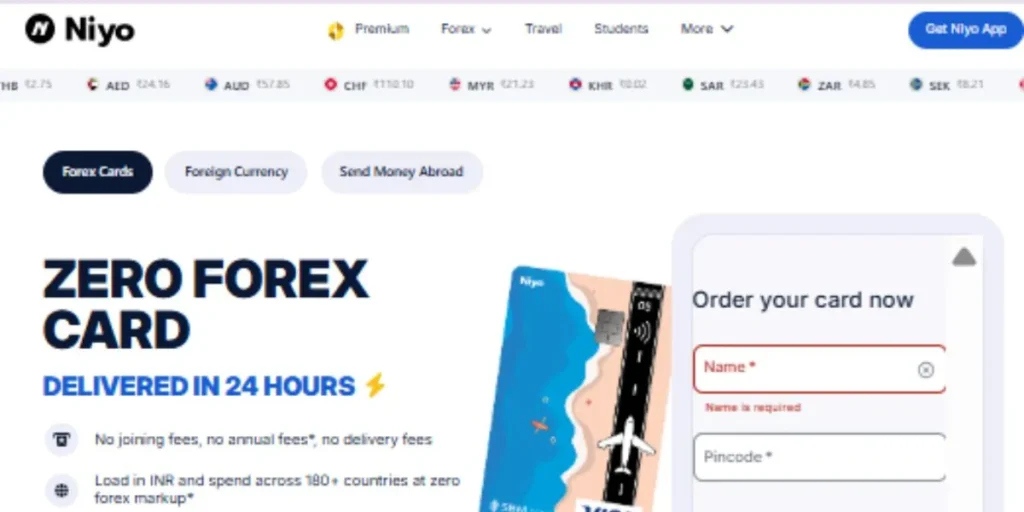
One of the oldest players is Niyo and has several different products. The most popular of its products is the Niyo Global card. People outside India who travel or study are in need of this card which is a life-saver. Why? It does not charge forex markup. By default, any transaction you make using your Indian debit card in a foreign country (such as the USA or UK), the banks impose a 3-5 percent fee on each transaction.
Niyo Global charges 0%. This saves the travelers a lot of money. They also possess NiyoX, a 2-in-1 savings and wealth account that is offered to people in India. It will also enable you to save money and also invest in mutual funds within the same app.
- Target Audience: International travelers, students studying abroad and millennials.
- Specialities: 0% foreign exchange (forex) markup on the Global card, 2-in-1 savings and wealth account.
- Best For: Any of the people who travel outside India or wish to have a simple account to save and invest.
- Website: goniyo.com
4. Open
Open is an executive in the business side of neo banking. It is not in your own savings. Rather it is designed to serve businesses, start-ups and freelancers. Open will provide them with a business current account which is interconnected with all their online business tools.
Through the Open dashboard, a business owner is able to collect payment, use and pay bills (invoicing) and send salaries to all his or her employees simultaneously (payroll). It is also integrated with accounting software and this makes the life of an accountant a lot easier. Open became the first neo banks in India with a business focus, which is a unicorn, or in other words, is worth more than 1 billion dollars.
- Target Audience: Startups, small and medium businesses (SMEs) and freelancers.
- Specialties: All-in-one (banking, accounting, invoicing), bulk payments, payrolls.
- Best For: Ideal owners of businesses who prefer to handle all their company finances under a single roof.
- Website: open.money
5. RazorpayX
You may have heard of Razorpay as a payment gateway (the box that pops up when you make an online purchase). Their business neo banks in India is called RazorpayX. It is its direct rival to Open. It provides businesses with a super-charged current account. It is highly powerful since it is related to the Razorpay payment system.
A company is able to receive money via the customers and through the same dashboard, the company is able to pay vendors or even payroll. It assists companies in abandoning the use of disorganized spreadsheets to track funds. It provides them with a clear picture of their cash flow.
- Target Audience: Small businesses, large businesses, startups, and the users of Razorpay.
- Specialities: Built in with Razorpay payments, automated payroll, vendor payments, and tax payments.
- Best For: Businesses (particularly online businesses) that require a smooth flow between the money gathering and expenditure processes.
- Website: razorpay.com/x/
6. Akudo
Akudo is a special neo bank designed to accommodate teenagers. Even in India, you are not allowed to get your own debit card before 18. Akudo solves this problem. It provides teens with a special prepaid debit card (which has their name printed on it) which can be controlled by parents.
The money can be loaded to the card via the app created by parents, and they can track how their child is spending the money. The app is built to be fun. It applies the concept of gamification, i.e. it rewards and points teens out because they save money. It educates them on finance in a manner that does not make it look like it is a dull course.
- Target Audience: Teenagers (ages 1118) and their parents.
- Specialities: Teen prepaid card, parental controls and tracking, saving gamified rewards.
- Best For: To teach the teens how to manage money and provide a harmless means to spend.
- Website: akudo.in
7. FamPay
The largest competitor of Akudo is FamPay, which used to target teenagers first. It also provides a pre-paid card that is controlled by parents. The big claim of FamPay is that the company has released the first numberless card in India. The physical card does not include a 16-digit number, expiry date or CVV on it.
This makes it very safe. In case a teen loses the card, no one will be able to use it online. All the card details remain safely within the FamPay app. It is a clever way of solving one of the biggest security problems. It also has a set of tools to assist teens in saving money and spending it just like Akudo.
- Target Audience: Adolescents and their families.
- Specialities: The first no-number card, UPI payments among teenagers and social payments.
- Best For: Parents who are concerned about the safety of their cards and are interested in allowing their teens some freedom.
- Website: fampay.in
8. Chqbook
Chqbook is a small business neo banks in India. Imagine a small grocery store, a small pharmacy, or the owner of a restaurant. Big banks tend to ignore these single-owner businesses. Chqbook has all the tools they require in a single application. It gives them a zero balance current account.
It provides a digital Khata to record money due to them, such as a digital notes book. It also assists them to obtain business loans, insurance and credit cards. It is a financial powerhouse to more than 60 million Indian small business.
- Target Audience: Shopkeepers, traders, chemists, etc.
- Specialities: Zero-balance current account, computerized khata, easy access to business loans and insurance.
- Best For: Small business owners that run their business on their phone.
- Website: chqbook.com
9. Freo
Freo identifies itself as a neo bank based on credit. That implies that it primarily extends credit. It started off as Moneytap, which provided personal loans which were flexible. Freo is a complete digital bank today. You are able to open a savings account (in collaboration with Equitas Bank).
You also have an opportunity to take a credit line or card or a pay later option when you are shopping. It allows individuals to make savings and borrow with the same application.
- Target Audience: People who desire savings and convenience in accessing credit.
- Specialities: Credit-based banking, Freo Pay (buy now pay later), and a digital savings account.
- Best For: Individuals seeking a credit card and loan within the same application, as well as those wishing to have a good savings account.
- Website: freo.money
10. Kotak 811
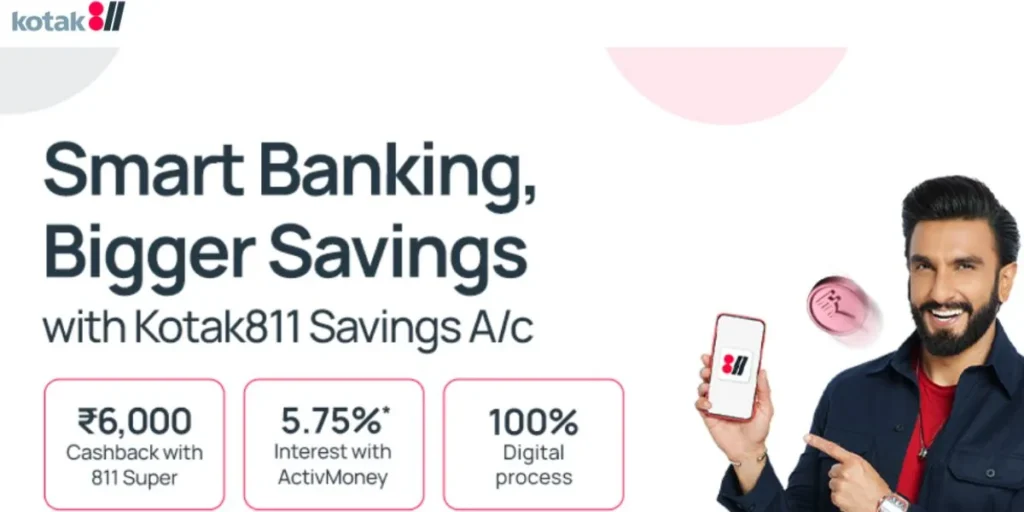
Kotak 811 is commonly referred to as a neo bank but it is a digital bank. The distinction is that it is not a start-up that is collaborating with a bank but a bank. Kotak 811 is a 100 percent digital, zero-balance account directly provided by Kotak Mahindra Bank, which is a very large and traditional bank.
You have the fast and simple registration of a neo bank, yet you have the confidence and all services of a large bank. It is as though it was a typical bank that created a neo bank within it.
- Target Audience: All people in India who desire a digital account with a large, reputable bank.
- Specialities: The real zero-balance account of a big bank, full-service banking, an ability to use Kotak’s branches in case of necessity.
- Best For: Individuals who desire the benefits of both a neo banks in India and a traditional bank the technology and the confidence, respectively.
- Website: kotak.com/811
Challenges and Risks
- No direct RBI licence: This is the biggest issue. neo banks in India are not real banks thus they exist in gray area. RBI is yet to decide on the rules they should be given, which is uncertain.
- They depend on partners: The neo bank cannot be stronger than its partner bank. The app of the neo bank will also cease to operate in case of technical issues in the partner bank.
- Building trust; Most Indians (particularly the elderly) have confidence in large, old bank buildings that they can see. They are frightened to invest all their funds in an app which does not have an office. Trust takes time to build.
- Making money: There are numerous neo banks that are not profitable. They offer zero balance accounts and huge cashbacks to lure users. They can hardly earn money when they offer everything for free. There will be a need to have a means of making money in the long run.
- Security risks: Due to their complete online nature, they are a large target to hackers. To ensure the safety of the app and your information they will have to pay a lot of money.
Outlook (The Future)
The neo banks in India have a bright future.
- Huge growth: The market is expanding at a very high rate. The number of people acquiring smartphones and the internet is increasing.
- New rules: The RBI understands the significance of neo banks. They are developing a new Digital Banking Licence. This will render neo banks formal and secure.
- Forcing old banks to change: Even those who do not use neo banks will be benefiting. They are also compelling the conventional banks (such as SBI and HDFC) to develop their own apps in a better way, reduce charges, and enhance service.
Conclusion
Neo banks are transforming the Indian thinking of money. Their task is not to displace large old banks. They come to collaborate with them. They combine the security and confidence of a conventional bank and combine it with the expediency and comfort of a technology company. Neo banks are a good option to young people, business owners, and whoever is fed up with the complicated banking system. They are easy, quick and designed to fit on the phone in your pocket. There is no longer a place to go to the bank; it is an app.
FAQs
Are neo banks safe? Is my money safe?
Yes. The neo bank app does not hold your money. Their partner bank (such as Federal Bank or ICICI Bank) will always have it. The DICGC will insure your money up to 5 lakhs, as any other bank account.
Is it possible that a neo banks in India will substitute my old bank account?
To use on a daily basis (sending money, paying bills, maintaining spends), yes. However, you may still require your old bank when it comes to big transactions such as a home loan, a car loan or a bank locker. It’s good to have both.
Why are neo banks free? How do they make money?
The majority of them are free to make you register. They make money in small ways. They may apply a small charge on the store whenever you swipe their card (interchange fee). Or they could make interest upon the sum of money everybody leaves in their hands.
Do neo banks give loans?
Some do. The Neo banks in india such as Freo are designed with the provision of credit. Chqbook is a business neo bank that assists business owners to obtain loans. Other ones, such as Jupiter, begin to provide small loans (such as a pay later option).