
Derivatives trading is getting more complex and now includes options, futures, swaps, and other structured instruments. Traders need analytics platforms that provide them with an extensive range of information about risk, pricing, and strategy performance in such a hectic environment. The right solution can help professionals and active traders understand complicated instruments, plan for different situations, and make decisions more quickly and with more information.
It takes more than experience and intuition to stay ahead in the rapidly changing markets of today. To make accurate choices quickly, traders require platforms that can process complex data, highlight key insights, and provide actionable analytics.
Top Smart Derivatives Analytics Solutions Reviewed
Derivatives trading requires data-driven analysis, real-time monitoring, and scenario modeling in addition to intuition. Leading analytics platforms help turn complicated derivatives data into useful insights by providing traders with the means to assess risk, test strategies, and predict market behavior.
Best Derivatives Trading Analytics Solutions
Allasso (Copilot)
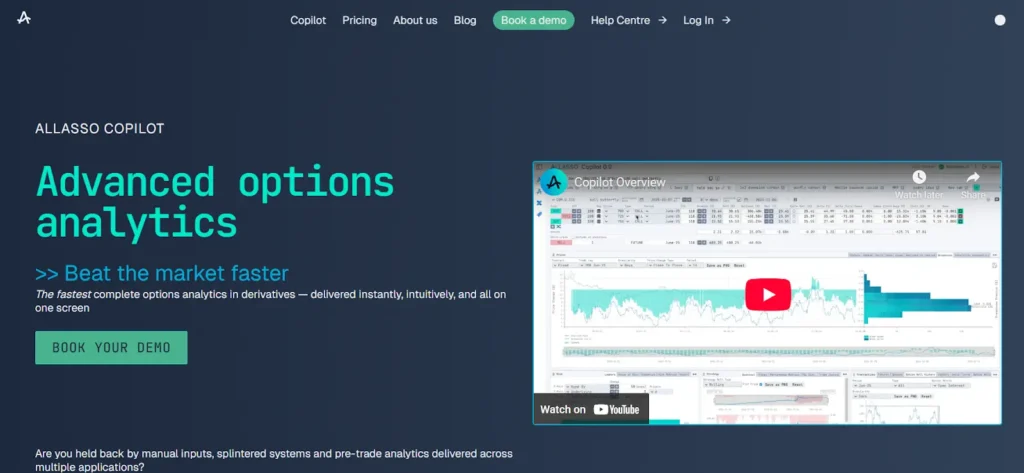
Allasso Copilot is a professional analytics platform made for derivatives traders who want accuracy and speed. It has a single interface that combines risk assessment, backtesting, scenario analysis, and collaboration. This makes it easier to handle complicated multi-leg positions across derivatives instruments.
The platform helps traders track performance, predict market movements, and make data-driven decisions without switching between multiple tools, thanks to features like real-time monitoring, customizable alerts, and comprehensive trade documentation. Its integrated approach improves overall trading efficiency and streamlines workflow.
Key Benefits
- Pre-trade analytics are used to evaluate probabilities, risk, and reward in derivatives strategies.
- Extensive market data is used in historical backtesting to check strategy assumptions.
- The necessary tools are used for stress testing and situations in price movement and volatility simulations.
- Open positions and changes in the market are tracked by real-time monitoring tools.
- Collaboration tools support teamwork and maintain organized trade documentation..
Why Consider Allasso
Allasso Copilot is worth considering for the following reasons and more:
- The solution is made just for analyzing derivatives, not for trading in general.
- There is a balance between depth and ease of use.
- The platform allows for risk management and strategy validation based on data.
- Allasso Copilot is the ideal choice for professional traders, funds, and people who know how to handle complicated portfolios.
In short, Allasso Copilot gives derivatives traders a single, outstanding space to work in. It is perfect for testing, tracking, and carrying out complex strategies because it has tools for historical analysis, forward simulation, and collaboration.
You may want to read: Top Trading Apps Without Investment
Orats
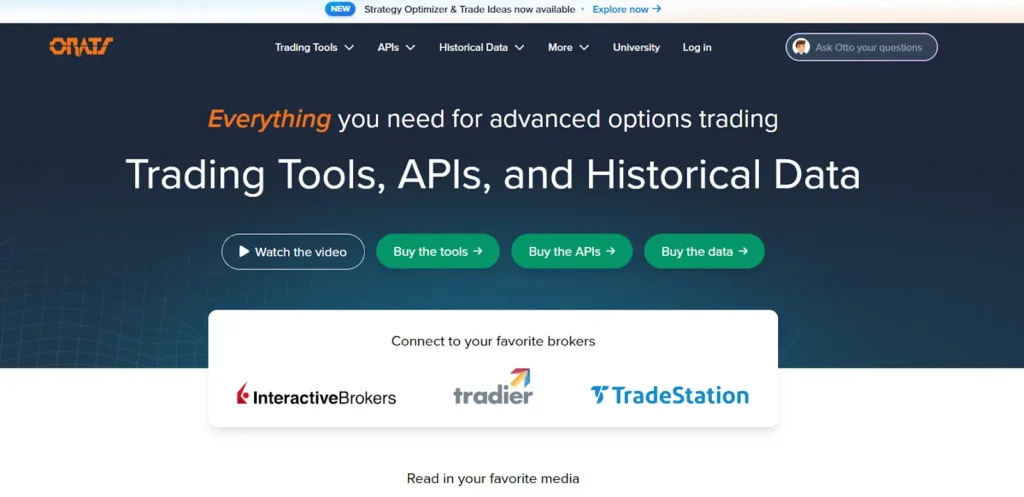
Orats is a derivatives analytics platform that helps you test options strategies, look at volatility, and make models automatically. It gives traders a lot of historical data, probability tools, and scenario simulations to help them improve their strategies and predict what might happen next.
Users can look at multi-leg positions, figure out how risky they are in different market conditions, and make better decisions, all on one easy-to-use platform.
Key Benefits
- The platform allows backtesting with data on historical volatility and options chains.
- It provides calculators for payoff and probability for multi-leg strategies.
- The solution includes tools to simulate various market situations and conditions.
- Orats provides dashboards that can be changed to keep track of portfolios and measure performance.
- It also allows for flexible analysis by working with Excel and other modeling tools.
- It delivers alerts and notifications for important strategy benchmarks and changes in the market.
For traders seeking in-depth, data-driven insights into options and derivatives strategies, Orats is the perfect choice. Its emphasis on scenario modeling, backtesting, and probability aids users in managing risk, improving strategy, and predicting possible market outcomes.
Market XLS
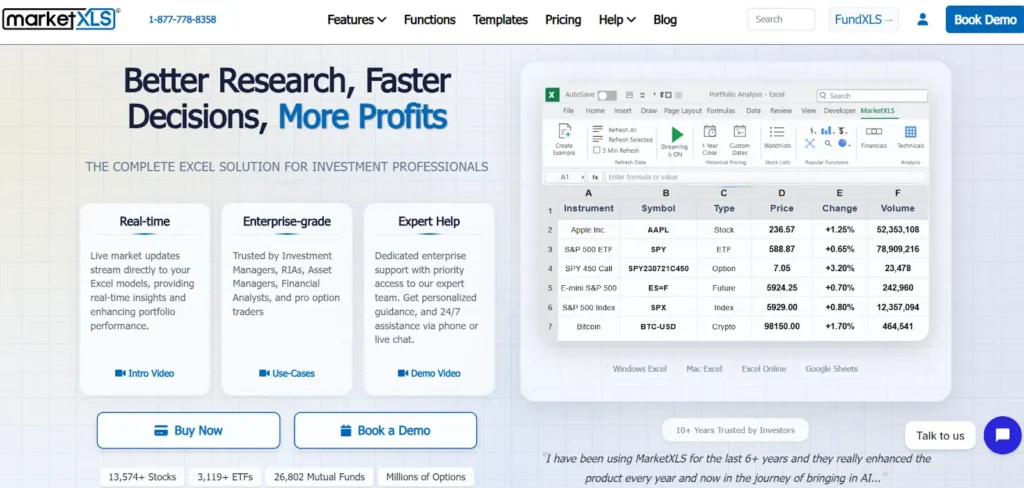
MarketXLS is an analytics tool that combines data from the derivatives market with Excel-based modeling. This gives traders a flexible and familiar place to work. It has tools for pricing, analyzing strategies, and managing risk.
Users can make their own models and see how multi-leg strategies work. Traders can also look at past data to test their strategies and keep an eye on live positions. This makes it easier to improve their strategies and react to changes in the market.
Key Benefits
- The analytics solution brings in real-time derivatives data into Excel to ensure you can do analysis on your own.
- It shows payoffs and lets you test your strategy for futures and options.
- The platform allows for calculating Greeks and risk metrics for complicated strategies.
- MarketXLS uses built-in templates and formulas to look at multi-leg options positions.
- It delivers signals and alerts when prices and volatility change.
- The solution gives you access to historical data so that you can look at trends and patterns.
In summary, traders seeking a highly customizable spreadsheet-based approach to derivatives analytics will find MarketXLS to be a strong option. It is appropriate for both professional and retail traders due to its integration of real-time data, risk modeling, and strategy testing.
Final Words
To stay ahead in fast-moving markets, manage risk well, and keep improving trading strategies, it is very important to pick the right derivatives analytics platform. The best solutions give traders the important information they need to make smart, confident choices by combining real-time market data, historical trends, and advanced modeling tools.
You can improve your strategies, make better decisions faster, and stay consistent even when the market is unstable by using these platforms. They also help you spot possible chances and risks sooner, which gives you an edge when planning and carrying out trades.
Today, start using these analytics tools to improve your derivatives trading, boost your performance, and trade with more confidence.
Here are 10 concise FAQs about the best derivatives trading analytics solutions:
1) What makes a derivatives trading analytics solution “best”?
A top solution combines real-time and historical data, robust backtesting, risk analytics, execution quality monitoring, and seamless integration with data feeds, brokers, and risk systems, plus strong security and scalable performance.
2) What data sources should a good analytics platform support?
Market data (level 1-3), order books, trades, options data, volatility surfaces, macro/news feeds, fundamental data, and risk/portfolio data from your OMS/EMS or TPS.
3) Why is latency important in derivatives analytics?
Lower latency enables faster decision-making, tighter spreads, better execution, and more accurate intraday risk and P&L attribution.
4) How important is backtesting and stress testing?
Essential. It validates strategies on historical data, simulates scenario shocks, and helps quantify risk and expected performance before live trading.
5) What should I look for in performance analytics (P&L, risk, prints)?
Realized/unrealized P&L by instrument, Greeks, VAR/ES, expected shortfall, Monte Carlo scenarios, drawdowns, and attribution by factor, strategy, or signal.
6) Can analytics help with options-specific trading?
Yes. Look for volatility surfaces, smile/skew analysis, Greeks sensitivity, implied vs. realized volatility, calendar/diagonal spread analytics, and risk-reward profiling.
7) How do I evaluate execution quality and slippage?
Seek metrics like implementation shortfall, VWAP/ TWAP vs. arrival price, participation rate, market impact modeling, and broker/venue analytics.
8) What about risk management features?
Real-time risk dashboards, portfolio VAR/ES, stress tests, scenario analysis, concentration alerts, margin and liquidity risk, and integration with risk controls.
9) Should the solution be cloud-based or on-premises?
Cloud offers scalability and faster updates; on-prem provides data sovereignty and custom control. Many firms opt for a hybrid approach to balance latency, security, and cost.
10) How important is data governance and security?
Critically important. Look for role-based access, encryption, audit trails, data lineage, and compliance with regulations (e.g., MiFID II, GDPR).