

Since delivering the first book from the small apartment in Bengaluru in 2007, the company has been on a mission to revolutionize the shopping landscape in the country. From being an audacious experiment by two IIT-Delhi alumni, the company has come a long way in its journey towards becoming the huge digital force it is today, serving over 500 million users in the country. Despite the arrival of global players in the market, the company still holds its massive 48% market share, making it a household name in bustling metros and quiet little towns alike.
In 2025, the company reported an enormous revenue of ₹82,787 crore, making its scale truly legendary in nature. Currently, the Flipkart Net Worth, in terms of its valuation, stands at an enormous $38 billion to $40 billion, making it the crown jewel in the global retail scenario, despite the challenges faced in its journey towards the top. Today, the company, now part of the global retail giant Walmart, is still pushing the boundaries in the quick commerce, fintech, and logistics space, making it a force to be reckoned with in the market scenario. In this article, we will delve into the details of the Flipkart, its financial status in 2026, and the leadership that is taking the company forward in the market scenario.
What Is Flipkart?

Company Background
Flipkart is not merely an application on your phone; it is the harbinger of the digital revolution in the country that forced traditional retailers to adapt to changing times. Before Flipkart Net Worth, it was not feasible for most Indians to buy expensive gadgets or even clothes online because of digital trust. Flipkart bridged this gap by introducing its “Cash on Delivery” concept, which was a harbinger for a population that was highly skeptical.
Additionally, Flipkart developed a world-class supply chain from scratch in a country where this was a major problem. The focus was entirely on providing a customer-centric experience, which helped Flipkart survive in its early days when internet penetration was extremely low in the country.
Origin & Founders
The Flipkart story began in October 2007 when the digital landscape in India was merely a fraction of what it is today. Sachin Bansal and Binny Bansal, who worked at Amazon, realized the potential for e-commerce in the country and decided to create something unique for Indians. They started Flipkart Net Worth with merely Rs. 4 lakh saved in their savings account and operated from a small house in Bangalore.
- They started as an online bookstore and then moved to other products to test the waters in general merchandise. This was a great strategy because they were able to develop a world-class logistical network for shipping small items.
- They acquired WeRead in 2010 to take its online bookstore to a larger audience. It was one of their early steps toward becoming a force to be reckoned with in the digital arena.
- They started their own logistics service, called Ekart, in 2012, so that they could have complete control over the delivery process.
- In 2014, they made a massive move by acquiring Myntra for a whopping ₹2,000 crores, effectively taking over the fashion segment.
- The final move came in 2018 when Walmart acquired a whopping 77% stake in Flipkart for $16 billion, the largest e-commerce deal in the world. This gave Flipkart the massive financial support required to compete with other giants without running out of money.
Flipkart Today
Fast forward to 2026; Flipkart has become a multi-headed giant. Flipkart is no longer just about shopping.
- Presence: Flipkart covers almost 100% of the serviceable pin codes in India.
- Infrastructure: Flipkart has a massive infrastructure of warehouses.
- Subsidiaries: Flipkart has subsidiaries such as Myntra (fashion segment), Cleartrip (travel segment), and Shopsy (social commerce segment).
- Tech-Forward: The company uses advanced AI to allow users to shop in local languages.
- User Base: Flipkart has over 500 million registered users; therefore, it is one of the most visited platforms in the country.
Flipkart Net Worth – Company Valuation
When someone asks about the Flipkart Net Worth, they are usually referring to the market valuation of Flipkart. Flipkart is a private company; therefore, its valuation depends on what investors are willing to pay for the shares of Flipkart.
Valuation vs Net Worth
It is also essential to know the difference between the two. “Net worth” is generally defined as total assets minus total liabilities, whereas “valuation” is defined as the estimated total value based on market potential and investor interest. The difference between company valuation and net worth is as follows:
| Aspect | Valuation | Net Worth |
| Definition | Estimated total value of the company based on market potential and investor interest | Total assets minus liabilities shown on the balance sheet |
| Purpose | Reflects future growth potential and market dominance | Shows the company’s actual financial position |
| Calculation Basis | Determined by investors, funding rounds, and market conditions | Calculated from assets, liabilities, and retained earnings |
| Funding Impact | Changes whenever the company raises new funding | Changes based on profits, losses, and asset values |
| Asset Consideration | Includes intangible value like technology, brand value, and logistics network | Includes tangible and financial assets recorded officially |
| Ownership Example | Walmart owns nearly 85% stake based on company valuation (2025–2026) | Ownership reflected as shareholder equity in financial statements |
Most Recent Valuation Figures for Flipkart
The Flipkart Net Worth in terms of valuation has witnessed a few ups and downs. The company’s valuation was adjusted when PhonePe was spun off, now a separate $12 billion company.
- Current Valuation: Estimated to be between $38 billion and $40 billion as per the latest reports in early 2026.
- Previous Peak: The company’s valuation touched $40 billion in 2021 when the pandemic-induced digital boom was at its absolute peak. During this time, all e-commerce-related metrics for Flipkart were touching new heights, as restricted movement forced people to shop online.
- IPO Targets: The company is reportedly aiming for a $60 billion to $70 billion valuation for its upcoming public listing. Achieving this target would represent a historic milestone for the Indian startup ecosystem as a whole.
Flipkart Net Worth in USD
As of early 2024, Flipkart’s valuation has been estimated to be between $35 billion to $40 billion USD after considering the PhonePe spin-off. However, some reports have indicated that there has been a decline in its valuation from its peak of $40 billion to a lower level. However, considering the internal factors, the company’s growth rate indicates that its valuation is still high, with Walmart holding an 85% stake in the company.
Key Valuation Details (approx.) as of 2024:
- Reported Valuation: $35B – $37.6B+
- Ownership: Over 85% owned by Walmart (acquired in 2018)
- Key Factors: The separation of PhonePe (now valued at over $12B) in 2023 caused a valuation adjustment.
- Growth: Reports show a 25-28% year-over-year increase in Gross Merchandise Value (GMV) in 2023.
Flipkart Net Worth in Rupees
As of early 2026, Flipkart’s valuation has been estimated at between $36 billion and $37.6 Billion USD, which translates to approximately ₹3 trillion to ₹3.15 trillion INR, based on recent funding and valuation reports. The company, owned by Walmart, remains a prominent e-commerce platform in India, with revenue growth, recording over ₹80,000 crore in annual revenue.
Key Financial Details:
- Valuation (2025-2026): Approx. ₹3-3.15 lakh crore ($36-$37.6 billion).
- Ownership: Walmart holds a 77.8% stake as of 2025.
- Revenue (FY24): The marketplace arm recorded revenue of ₹17,907 crore, growing 21% YoY.
- Total Turnover (FY24): Including subsidiaries, revenue was reported around ₹82,787 crore.
- Losses: The company reduced its losses by 41% to ₹2,358 crore in FY24.
Flipkart Revenue & Profit (Financial Performance)
Flipkart Net Worth , like every tech giant, is a high-growth, high-burn business model. For an e-commerce company in an emerging economy, the focus is almost always on acquiring the land before worrying about the bottom line.
Latest Revenue Figures 2026
The latest revenue figures available for the company for the year 2025-2026 show the enormous scale at which the company is operating, as well as its status as the current driver of the digital retail economy in the country, even in the face of an increasingly complex global market scenario.
- Massive Top-line Revenue: Flipkart’s consolidated revenue for the financial year 2025 stood at a massive ₹82,787 crore.
- Significant 17.3% Jump: This shows a sharp double-digit growth compared to the previous year’s figures, proving that the move to online shopping in India is here to stay.
- Marketplace Efficiency: The core marketplace business saw its revenue rise to ₹20,746 crore, along with its standalone losses being trimmed by an impressive 37%.
- Advertising Powerhouse: Advertisements on the platform saw a rise of 27% to over ₹7,200 crore, which acts as high-margin brand marketing for Flipkart’s overall Flipkart Net Worth.
- Rural Connectivity: This growth can be attributed to an increasing middle-class population and improved rural internet penetration, with 60% of its new shoppers being from Tier-2 and Tier-3 cities.
- Quick Commerce Push: The launch of “Flipkart Minutes” aims to achieve high-frequency daily spend to fuel its revenue growth through late 2026.
Is Flipkart in Profit or Loss?
The short answer to this would surprise most people: Loss. This is despite the massive revenue generation for the company, with a consolidated net loss of ₹5,189 crore in FY25. However, experts say that these are not losses but investments in a market that will be worth trillions in the future.
- Widening Gaps: The loss was 24% more than FY24. The increase in cost was due to the increase in supply chain and employee costs, making the widening gap a concern for conservative investors.
- Cost of Goods: The majority of the money is spent on purchasing goods. The stocks are kept at maximum levels to ensure sales during festive seasons.
- Marketing: The expenses incurred in advertising the Big Billion Days sale and spending crores in advertising via celebrities are huge. These are required to keep the brand at the top of the customer’s mind.
- Logistics: Delivering a ₹200 item to a remote village in the Himalayas is incredibly expensive and often results in a loss per order. However, Flipkart views this as a necessary cost to build a truly national brand and lock in customers.
Flipkart CEO & Leadership
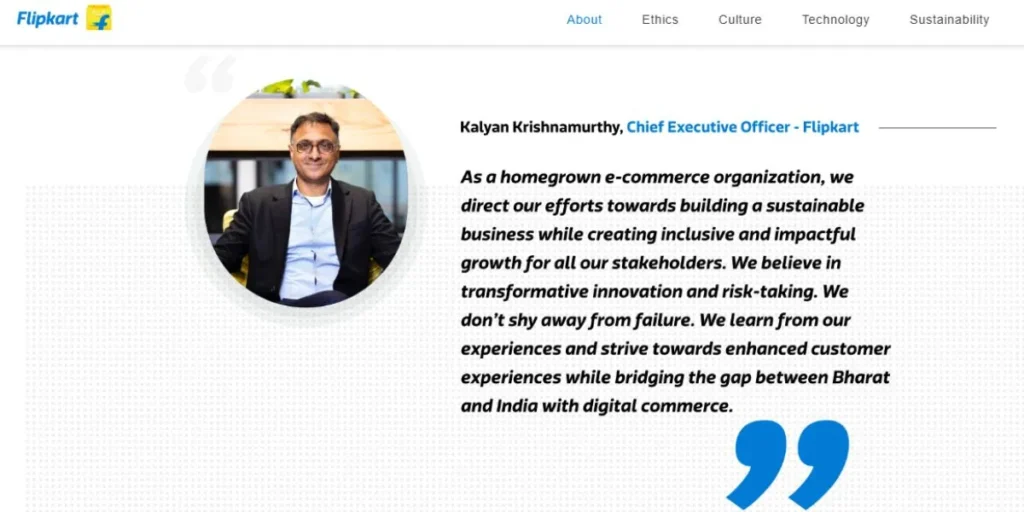
The leadership at Flipkart has gone through a sea change ever since Walmart acquired Flipkart in 2018. The founders are responsible for providing vision and sparking the dream. The rest is taken care of by a team of global corporate leaders.
Who Is the CEO of Flipkart?
Kalyan Krishnamurthy has been the CEO of Flipkart since January 2017 and has successfully navigated the most turbulent yet successful years of the firm’s history. He has been credited with winning the ‘E-commerce Wars’ against global players with his focus on local Indian needs.
Flipkart CEO Salary & Net Worth
While the exact figures are not disclosed in private companies, industry standards for a company of this scale give us a very good idea of what the figures would look like. The stakes are very high for the management given the Flipkart Net Worth.
- Estimated Salary: His salary would be in the multi-million dollar bracket when we consider all the perks and benefits attached to the role.
- Average Exec Pay: High-level VPs/Directors at Flipkart are reportedly being paid between ₹1 crore to ₹5 crores on an annual basis, along with very high stock options.
- Wealth Source: A very high percentage of the CEO’s wealth comes from ESOPs (Employee Stock Ownership Plans) that are linked to the valuation of the company.
Flipkart Founder Owner Net Worth
Although the Bansals are no longer associated with the company, their names will always be associated with the history of Indian entrepreneurship. They were the pioneers who took the first risk when the concept of “buying online” was considered a distant dream for most Indians. The successful exit of the founders from Flipkart Net Worth created a model for an entire generation of Indian tech entrepreneurs.
Sachin Bansal’s Net Worth
Sachin Bansal’s current net worth is estimated to be around $1.2 billion, and he is considered a billionaire. Although he exited the company, he didn’t take a break and started another company called Navi Technologies, providing digital financial services to customers. His focus has shifted from retail to the massive fintech and insurance market in India, where he hopes to replicate his previous success.
Binny Bansal’s Net Worth
Binny Bansal also has a similar net worth of $1.4 billion, considering the shares he retained from the initial Walmart deal. Today, he is considered one of the most active angel investors in India and has invested in dozens of startups. This has given him a lasting impact on the growth of the next generation of “unicorns” in India.
Who Currently Owns Flipkart?
Walmart owns a majority of its shares, currently holding between 77.8% to 85% of its total outstanding shares, as a result of buying out its early investors in multiple rounds of fundraising. The rest are owned by a handful of international investment entities, including Tencent, and a few of its own employees.
Flipkart Shopping – Services & Business Model
It is a common question on everyone’s mind about a company that is making thousands of crores in losses, yet is so highly valued by the smartest investors across the world. The answer lies within its business model, which is all about creating a “sticky” platform that becomes a part of one’s daily life.
What Does Flipkart Offer?
- Electronics: It is the market leader when it comes to launching exclusive smartphone models and buying large appliances such as TVs and washing machines. The “Exchange Program” and “No Cost EMI” schemes help consumers buy expensive gadgets for their homes, which are a necessity for each and every Indian family.
- Fashion: With its acquisition of Myntra, Flipkart is currently dominating this space, offering everything from daily wear to high-end luxury designer wear.
- Grocery: Flipkart Grocery is growing rapidly to capture a significant portion of this space, competing against established players such as BigBasket, providing doorstep delivery for daily groceries to its consumers. It has built its own cold chain of stores to deliver fresh produce to its consumers, including those living in Tier-2 cities.
- Quick Commerce: They are now actively testing their “Flipkart Minutes” service, a 10-minute delivery service in metros to compete with Zepto and Blinkit.
- Travel: With the acquisition of Cleartrip, they have now made seamless bookings of flights, hotels, and holiday packages available within the Flipkart app.
How Flipkart Makes Money
Here is how Flipkart makes money:
- Commission: They take a certain percentage of all single sales made by millions of third-party sellers featured on their platform.
- Advertising: Brands pay enormous amounts to secure the top spots in the search engine results or the banners on the home page.
- Logistics Fees: It charges sellers for the entire process of picking up, packing, and delivering the products through their internal logistics arm, Ekart.
- Subscription: The “Flipkart Plus” program is used to retain customers through offers of free fast delivery and early access to sales.
Flipkart vs Amazon – Which Is Richer?
This is the ultimate battle of the titans that has been going on in the Indian market for more than a decade now. While one is a homegrown hero with the backing of a US giant, the other is a global superpower with a presence in almost every country on earth. The competition between the two has only helped consumers, as prices as well as delivery times have reduced for everyone.
| Feature | Flipkart | Amazon (Global) |
| Valuation | ~$40 Billion | ~$2 Trillion+ |
| India Market Share | ~48% | ~31% |
| Parent Company | Walmart | Independent |
Though Amazon, Meesho net worth may be a bigger global giant with a massive cloud computing business (AWS) that makes it a billion dollars in profit, Flipkart remains the undisputed leader in the Indian e-commerce market. In their “Big Billion Days” sales extravaganza, the Flipkart Net Worth impact can be seen as they beat Amazon India in terms of sales volume as well as Gross Merchandise Value (GMV).
Why Flipkart Still Operates at a Loss
It may seem strange to a traditional business person that a giant company loses thousands of crores every year without going bankrupt. However, in the world of venture capital as well as high-tech retail, these losses are considered the “price of admission” for a long-term monopoly position.
- Market Share: They would rather be the #1 player than a profitable one today because the winner in e-commerce will win the whole market. They can gradually raise their prices as they achieve a certain level of market dominance.
- Infrastructure: It costs a lot to build a network of hundreds of warehouses as well as thousands of delivery hubs in a country as diverse as India. This will pay off for them for decades to come, even if their books do not balance today.
- Customer Acquisition: Discounting heavily to acquire millions of new customers is a huge expense, but a necessary one. The aim is to retain a new customer as a long-term customer who will spend money on the platform for the next 20 years.
- Expansion: Currently, they are investing a lot to win in the high-frequency segments of “Grocery” and “Medicine,” which demand brand-new supply chains. These new business ventures are a temporary drag on profitability but are vital for future growth.
- Long-term Play: Walmart is making a strategic long-term investment through Flipkart Net Worth to win the future of India retail, which is expected to be a $2 trillion industry by 2030.
Flipkart Net Worth 2026: What to Expect
In the near future, the Flipkart Net Worth is expected to touch even greater heights, as the company is moving towards its much-awaited IPO. It is assumed that in the near future, the market conditions will remain favorable, and the company will list its shares in the stock exchanges in the later part of 2026, thereby increasing its valuation from $60 to $70 billion instantly.
- IPO Valuation Growth: Flipkart is aiming to list on the stock exchanges at a valuation ranging from $60 billion to $70 billion through its much-awaited IPO.
- Redomiciling to India: The strategic planning for a smoother IPO process is already underway, with Flipkart planning to shift its headquarters from Singapore to India.
- Strategic High-Margin Entry: The entry into high-margin businesses such as advertising and fintech (via Super.money) is expected to help the company reduce losses significantly.
- Quick Commerce Momentum: The rapid growth of ‘Flipkart Minutes’ aims to capture the $40 billion quick commerce market to create a high-frequency shopping cycle for consumers.
- AI and 5G Adoption: With more Indians accessing 5G technology, Flipkart aims to invest 6X more in AI to create a more personal shopping experience for the growing ‘Next Billion’ user base.
- Economic Pillar Status: From being a startup to becoming an economic pillar for the Indian economy, Flipkart has become an agent of digital transformation in almost every pin code in the country.
Conclusion
The journey of Flipkart from being a small bookstore to a $40 billion giant today is a true testament to the potential of the Indian consumer market. Though still struggling to become profitable, Flipkart’s massive scale and its parent company, Walmart, ensure that Flipkart is here to stay. The Flipkart Net Worth continues to represent the massive potential of the Indian digital economy.
Whether it is through its 10-minute grocery delivery or its exclusive smartphone launches, Flipkart has become an integral part of the Indian lifestyle. As the company gears up for its historic IPO, the next few years will define whether this e-commerce giant can become profitable from its massive revenues.
Visit For More Information:
FAQs
1. What is the total Flipkart net worth in 2026?
Flipkart is presently worth $38 billion to $40 billion, which is equivalent to about 3.3 lakh crores in Indian currency. This reflects the company’s strength in the fastest-growing retail market in the world.
2. Who is the real owner of Flipkart today?
The American retail corporation Walmart owns the majority of the shares, i.e., 85% of the total shares of Flipkart. The original founders of Flipkart, Sachin Bansal and Binny Bansal, are no longer involved with the company.
3. Why is Flipkart still making losses?
The focus of Flipkart is on rapid market penetration, building massive logistics infrastructure, and offering huge discounts to its customers. This is being viewed as an investment for the future market leadership by its parent company, Walmart.
4. Is Flipkart an Indian Company?
Yes, Flipkart was founded in India, and its massive operational headquarters are located in Bengaluru, India.
5. What is the salary of the CEO of Flipkart?
While the exact figures are not publicly known, the total compensation package for the CEO of Flipkart, Kalyan Krishnamurthy, is estimated to be in the millions of dollars.
6. Who is richer, Flipkart or Amazon?
While on a global platform, Amazon would be infinitely richer with a market capitalization of over $2 trillion and a presence in more than a dozen countries, Flipkart would still be richer in terms of market share and sales volume in the Indian market.