How to start a vending machine business is a question many aspiring entrepreneurs are asking today. The vending machine business is an option that is gaining popularity among individuals who seek to start a business with a minimum of investment and fewer day-to-day hassles. Due to the fast-paced lifestyle and the growing preference for convenience and contactless purchasing, people increasingly rely on quick and automated ways to buy food, beverages, and daily essentials. Vending machines fit perfectly into this modern demand.
You no longer require a physical store, employees, or extended working hours to operate this business. Customers are served through the automatic mechanism of a vending machine, which remains available day and night. Offices, hospitals, schools, metro stations, and other public places are actively looking to install vending machines to provide easy access to snacks, drinks, and necessities.
For beginners, this business offers a simple and practical way to enter entrepreneurship without prior experience. With proper planning, the right location, and smart product selection, the vending machine business can become a steady source of income while offering the flexibility to manage it alongside other jobs or commitments. In this blog, we will explore how to run a successful vending machine business.
What Is a Vending Machine Business?
The vending machine business is a variety of automated retail businesses in which the products are sold at the machines rather than in a conventional store. These machines are located in places where people frequent them frequently, like offices, hospitals, colleges, airports and also in open places. The customers will be able to choose a product, pay digitally and get the item without any human contact.
The modern vending machines that are used in India take UPI, cards, and mobile wallets. Thus they are very convenient and secure. The business owner will install the machine, stock, maintain the machine and sales tracking. Products may include snacks and drinks or even fresh food, medicine, hygiene and even electronic accessories. It keeps on making sales even in your absence. This renders the vending machine business a brilliant investment to consider when a passive income with a minimum of operations is sought.
Why Start a Vending Machine Business in India?
- Low Involvement Business Model: Vending machines use significantly less capital and eliminate the need for rental space compared to setting up a shop or franchise.
- Minimal Daily Effort: The machine can be installed to run automatically and it only requires infrequent refilling and maintenance.
- 24×7 Income Opportunity: The vending machines operate day and night making sales even when you are asleep.
- Training and Staff not neede: One does not need to invite workers or pay raises, attendance and training.
- Easy to Scale and Expand: It is possible to add more machines to new areas without adding workload to a considerable extent.
- Best with First-Time Entrepreneurs: It is easy to operate and low risk and hence is best suited to beginners and side-income seekers.
How to Start a Vending Machine Business: A Complete Guide

Step 1: Knowledge of the Market and Demand.
You need to know where vending machines can be found and why they are there before you can spend so much as a single rupee. A vending machine would not be sold because it is there, it would be sold because people want to get it immediately at that place.
Vending machines will be effective in locations where individuals spend a lot of time or need to travel a lot and demand a quick solution in India. Examples include offices, hospitals, colleges, metro stations, gyms and hostels. These locations are busy in terms of people walking in and have little time in conventional shopping.
Knowing the demand also implies knowing with whom one is buying. Down-town workers like healthy snacks, coffee or fast foods. Students seek cheap confectionery and beverages. Hospitals require water, juices and necessities. Protein bars and health drinks are favored by gym users.
As soon as you know the place and customer dynamics, you will be able to make decisions regarding which products to keep, which price is to be offered, and what quantity of sales you may get. This is what determines your machine to be successful or a failure.
Key points
- Answer footfall and the everyday schedule of individuals.
- Location: match the product demand and location.
- See what other people already buy around.
- Risk is mitigated by demanding knowledge.
Step 2: Determine What You Are Going To Sell.
Your vending machine only makes money from the products placed inside it, which is why product selection is more important than choosing the machine itself when you start a vending machine business. A high-quality machine loaded with the wrong products will not perform well.
The first step is to select products based on location-specific needs rather than personal preferences. For example, hospitals perform better with water, juices, light snacks, and hygiene items, while offices see higher demand for coffee, snacks, and ready-to-eat meals. Gyms typically generate better sales from protein bars and health drinks.
Always begin with fast-moving and well-known products. Avoid rare or expensive items in the early stages, as customers prefer low-risk purchases. Smaller, affordable pack sizes tend to perform better, and new product categories can be introduced gradually once sales data is available.
Daily monitoring helps identify which products sell consistently and which do not. This allows you to remove underperforming items, optimize inventory, and increase overall profitability.
Key points
- Match products and type of location.
- Begin by selling popular and low-end products.
- Pilot test products prior to rolling out.
- Stock is updated according to sales information.
Step 3: Investment And Cost Structure Planning.
Proper investment planning will save you from financial stress in future. Vending machine business is not that simple as it may seem and they need to be clear in budgeting.
The price of one vending machine in India ranges between 1.3 lakh and 1.5 lakh based on features. Installation, electric fixing and connectivity might cost an extra of 5000 rupees to 10000 rupees. Initial stock usually needs 10-20000.
Then, the cost of your investment in any one machine will be around 1.5 to 1.7 lakh.
Besides this, you will have low monthly costs such as restocking, electricity, and the occasional maintenance. No shop rent or staff salary in case of positioning it wisely.
The step assists you in computing the number of machines you can afford and duration of recovery.
Key points
- One-time setup cost is fixed
- The costs per month are low.
- No employees, no store rental needed.
- Budget determines magnitude and rapidity.
Step 4: Revenue And Profit Potential.
The revenue of the vending machine is primarily dependent on location, price, product mix. No fixed income but realistic estimates assist in planning.
There is an average product price of 25-50 (INR). Depending on the number of people who visit a day, a machine can sell 20 to 75 items. This has the potential of generating around 30,000-50, 000 per month.
The average vending machine profits have a payback period of 12 to 18 months. Subsequently, the machine will be a long term profit bearing low running cost asset.
Positioning of the machines in strategic positions with high traffic and stocking them wisely enhances profit. The largest cause of poor returns is poor location.
Key points
- Income varies by location
- ROI is enhanced in the post-cost recovery.
- Earnings are high in the long-run.
- Intelligent positioning makes more money.
Suggested Read:-
Step 5: Select The Appropriate Vending Machine.
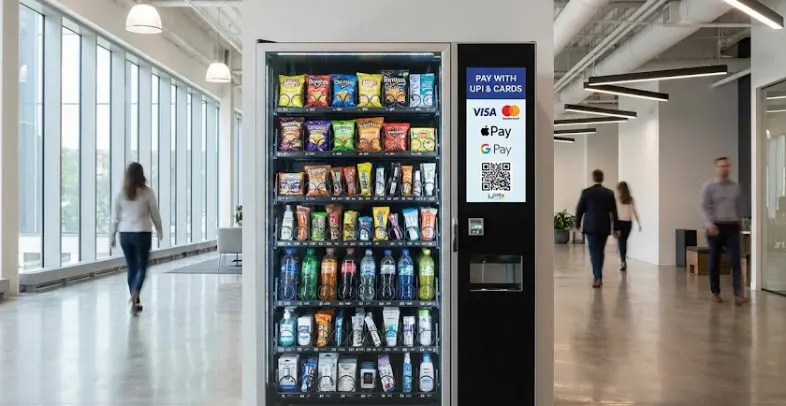
Vending machines are not all alike, and choosing the right one is essential when you start a vending machine business. The correct machine can save money and prevent operational issues in the long run.
Modern vending machines should support cashless payments, especially UPI and card options. Remote monitoring is useful as it allows you to track sales and stock levels without daily visits. Energy-efficient machines help reduce electricity costs, and high-quality construction ensures durability.
Select the machine type based on the products you plan to sell—snack machines, beverage machines, combo machines, or fresh food machines. Larger machines are suitable for offices and transit stations, while smaller machines work well in gyms or hostels.
After-sales support is important. A machine that seems inexpensive but lacks proper service coverage can become costly over time.
Key points
- Select machines according to products.
- It is critical to pay cashless.
- Remote monitoring saves time.
- Service support is critical
Step 6: Choose The Appropriate Location.
The one most significant element of success of a vending machine business is location. The most suitable machine with the appropriate products will not work unless it is located in such places where individuals do not make frequent visits. A vending machine functions on impulse buying and this means that people should simply see it and reach it without any hassle.
Office buildings, hospitals, metro stations, colleges, hostels, gyms and waiting rooms are all good places. The especially well-performing entry and exit points, cafeterias, and corridors are so due to the fact that people naturally slow down or wait there. Space is not as important as visibility.
Location agreements typically operate in two forms, which are revenue sharing and fixed rent. Share of revenue is less risky to novices and fixed rent is used when the footfall can be assured. Never sign any agreement without estimating the sales which are likely to be achieved as poor location may result in low sales on a monthly basis.
Key points
- Location size is not as significant as footfall.
- Easy access enhances the areas of impulse buying.
- Select business conditions that fit in with your budget.
- Bad location will cause bad and unstable revenue.
Step 7: Procurement of Needed Licenses And Compliance.
It is significant to operate your vending machine business lawfully to prevent punishments, close up, or future headaches. You need to have an FSSAI registration in case your machine is selling food or beverages. This will guarantee the observance of food safety and hygiene standards.
The billing and tax compliance in the GST registration is also required in case you intend to grow or operate with corporate clients. Certain spots might also involve local trade license or a permission by the property owner or municipal authority.
Machines should meet the electrical safety standards, all products must be well labeled with expiry dates and ingredients. Depending on the state in which you are setting up your initial machine, regulations may vary and hence before doing so, you should ensure you verify the local regulations.
Key points
- FSSAI is compulsory on food vending.
- The business operations need to be registered under GST.
- Electricity and hygiene should be adhered to.
- Compliance locally eliminates future legal problems.
Step 8: Operations And Stock Management.
A vending machine can only make a profit when it is well-stocked and operating efficiently, which becomes especially important when you start a vending machine business. A machine that is out of service or malfunctioning leads to lost sales and dissatisfied customers. Proper inventory management ensures consistent revenue and builds customer loyalty.
Fast-selling products should always be refilled first. Using the FIFO method helps reduce waste from expired items. Avoid filling machines with too many slow-moving products, as they occupy valuable space and restrict cash flow.
Regular cleaning and technical checks are essential. A clean, well-maintained machine builds trust and encourages repeat purchases. Remote monitoring dashboards further simplify operations by allowing you to track sales, stock levels, and machine health without daily visits.
Key points
- You cannot leave machines idle.
- Major on products that move quickly.
- FIFO to prevent losses caused by expiry.
- Clean and well-maintained machines also increase trust.
Step 9: Sales And Marketing Development.
Vending machines do not require marketing, which is a common myth among people, yet a promotion is important in boosting sales. First time buyers are attracted by launch offers and discounts, and people can try the machine with the help of such offers.
Gift deals persuade the customers to purchase over one product. Popular products and offers can be considered with the help of simple signage or stickers. Monitoring of the sales allows determining the best places and products.
When you have found the working places, it is possible to use the same strategy in other places. Collaborating with local brands or food companies would also be able to generate revenue by placing sponsored products.
Key points
- First time users are attracted through promotions.
- Both combo offers and bundling boost average order value.
- Statistics can be used to determine optimal places.
- Brand alliances generate new revenues.
Step 10: Scaling The Business
A vending machine business is one of the easiest ventures to scale when you start a vending machine business. Once a single machine becomes profitable, you can add more machines without increasing manpower or daily workload.
Modern vending systems allow you to manage multiple machines through a single dashboard, giving real-time visibility into sales, inventory, and location performance. This makes expansion across cities or even states simple and manageable.
Growth costs remain affordable because there is no need to hire staff or rent physical shops. This is why vending machines are widely regarded as a highly scalable business model with strong future potential.
Key points
- Increase size without the need of additional employees.
- Centralized monitoring is time saving.
- Growth between cities is not challenging.
- Great growth at minimum operational effort.
Guidelines On How To Manage Your Vending Machine Business.
- Monitor Sales Regularly: Monitor daily and weekly sales statistics to know what products and places are better to sell and what should be improved.
- Keep Machines Well Stocked: Refill fast-moving product in time so that the machine does not remain empty and customers can always find what they want.
- Choose the Right Product Mix: Produce products according to the preferences of customers, time of the year and the place to ensure that sales remain the same.
- Keep Clean and Hygienic: Wash the machines frequently to develop trust in the customers and make them use it again.
- Carry out Routine Maintenance: Periodically check the payment problems, sensor mistakes or technical problems to prevent losses in time.
- Use Remote Monitoring Tools: Check the status of inventory, sales, and machine health without visiting locations daily with the help of leveraging dashboards.
- Rotate Slow-Moving Stock: Clear low-selling or almost expired goods within a short duration of time in order to minimise losses and create space to stock superior goods.
- Provide Multiple Methods of payment: Make sure that UPI, cards, and digital wallets are functioning well to prevent losing of impulse buyers.
- Establish Relationships with Good Locations: Have good relations with property owners to have long-term placement and favorable terms.
- Review Performance Monthly: Examine profits and costs and the performance of the location monthly to strategize on improvement and further development.
Common Mistakes to Avoid
- Although it may seem that the business of a vending machine is easy, there are a lot of small mistakes that many new entrepreneurs make which result in low performance. By averting these pitfalls, you are likely to be successful.
- Poor Location Selection: The worst and most expensive error is to select a place lacking good footfall. It will not be possible to sell using a vending machine in a place where people do not usually stop and pass by it, no matter how good the products are. Movement patterns should always be studied before being installed.
- Limited Product Variety: Having insufficient or duplicate stock minimizes the interest of the customer. When individuals observe the same products each time, they will stop using the machine. An equal combination of trendy, low-cost, and place-based products keeps the customers entertained.
- Ignoring Maintenance: The dirty or malfunctioning machines lose customer faith very fast. Failure to pay or jamming of products frustrates and makes sales to be lost. Cleaning and technical checking should be done regularly to ensure smooth operation.
- Not Tracking Sales Data: It is like driving without purpose to run machines without checking sales. Sales information makes you know what sells, what does not and at what time you need to refill. Disregard of data results in poor decision making and wastage.
- Overinvesting Un-tested: When the installation of multiple machines is done without the testing of any one location, it may be a drain of capital. To mitigate the risk, always begin small, test the demand and then go bigger as demand rises.
These practices can be avoided, and they will assist in the establishment of a stable and profitable business of vending machines.
Pros of Vending Machine Business
The vending machine venture has a number of viable benefits that have rendered it appealing to both the novice and the established business persons.
- Low Investment, High ROI: Vending machines do not demand much startup capital compared to other businesses, but they have a good potential of earning in the long run.
- Minimum Time and Effort: Machines mounted automatically and require refilling and maintenance after some instances.
- Long-Term Returns: Vending machines have a high life cycle and they earn a lot of money many years into the future after recovering the costs.
- Wide Product Range: You can sell a great variety of products, including snacks, drinks, and even medicine and necessities, by use of vending machines.
- Be Your Own Boss: You have full control of your business without having to manage staff or supervising them on a daily basis and it is therefore suitable to part-time entrepreneurs.
Conclusion
The vending machine business in India is an intelligent and futuristic move. As demand for convenience and contactless purchasing continues to rise, vending machines are becoming an important part of modern retail. With proper planning, the right location, investment in quality machines, and efficient operational management, this business can deliver consistent and scalable returns.
A vending machine business is a strong venture to consider if you are looking for a low-risk opportunity, a source of passive income, and long-term growth. This guide explains how to start a vending machine business in India, covering everything from idea to execution to help you successfully launch and operate your venture.
FAQs
1 What is The Amount Required to Establish a Vending Machine Business?
The average cost of a vending machine ranged between 1.5 and 1.7 lakh including set up plus inventory.
2. Is a Vending Machine Company Business Viable In India?
Yes, when the right place and products are used, majority of the machines break even in 12-18 months.
3. Is There a License That I Require To Operate The Vending Machine Business?
FSSAI is not mandatory to food products and GST registration is not to business activities.
4. Is It Possible To Operate a Vending Machine Business On a Part-Time Basis?
It suits the part time entrepreneurs because machines are automatic.
5. Which Products Move Best In Vending Machines?
Depending on the location, snacks, beverages, ready-to-eat food, and healthy items selling are best.