
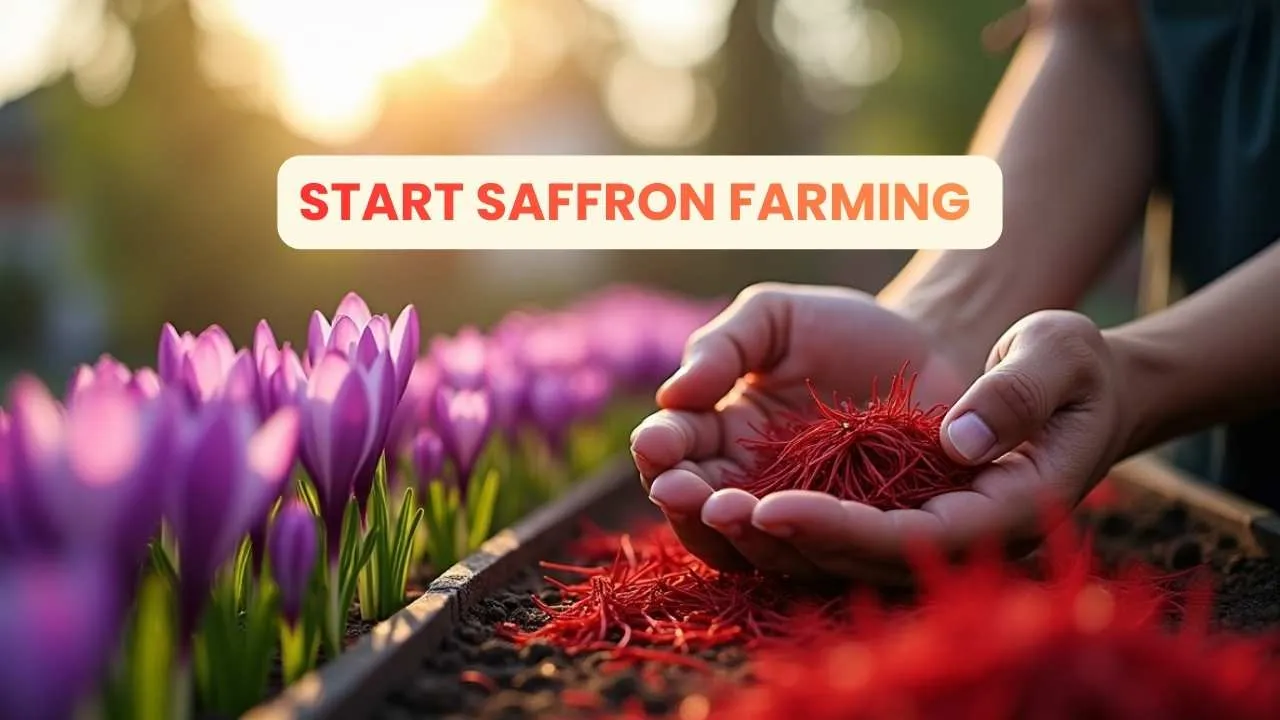
Saffron is the world’s most expensive spice, often referred to as “Red Gold.” It can be cultivated either in your backyard or on a balcony, in your spare room or your garden. This might appear to be something that can be done only by large farms in cold locations, but new techniques allow amateurs to cultivate their own saffron.
This resource will guide you step by step through the details of growing saffron crocus and harvesting its threads. We discuss the selection of the bulbs, cultivation, and sales of the product to generate additional revenue.
Introduction: The Magic of Saffron.
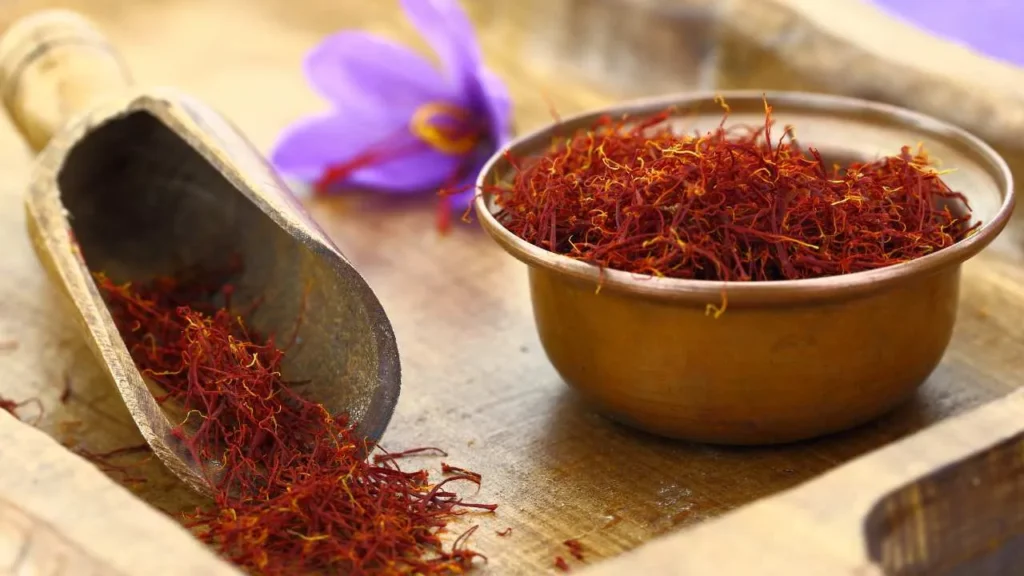
Saffron is not just a spice, but a well-known spice. It extracts itself from the dried and minute thread-like sections of the saffron flower. These are threads that are appreciated all over the world due to their red colour, smell, and taste.
The following are some of the briefs that indicate the specialness of saffron:
- Labour: 75,000 to 150,000 flowers are required to produce 1kg of saffron threads. It is so costly due to the effort required.
- Price: 1 kilogram of saffron costs between 25,000 and 100,000 when purchased in stores. It weighs more than an equal quantity of gold.
- Production: About 300 tons of saffron are produced annually, with most produced in Iran.
- Yield: Each flower produces only three threads, which must be picked by hand.
- Saffron cultivation: It is a very exciting and gratifying venture. Let’s start.
You Might Like: List of All Agriculture Business Ideas
Saffron Farming in India
India has a long and rich history of saffron, with many of its production areas located in unique regions.
Key Saffron-Producing Areas.
Conventionally, the cultivation of saffron in India has been a speciality of a region, but it is gradually spreading:
- Jammu and Kashmir: The Indian saffron is the origin of this area. Saffron is famous in places such as Pulwama, Budgam and Srinagar. It grows in the special soil known as Karewa soil and has a cold climate at 1,500 -2,000 meters. The region known as Pampore is referred to by people as the Saffron Bowl of Kashmir.
- Other Areas: Due to the emergence of indoor techniques, farmers in states such as Himachal Pradesh, Uttarakhand, Maharashtra, and Karnataka can cultivate saffron in buildings or greenhouses nowadays.
Legal Aspects
When you are a backyard farmer, you are not very likely to be forbidden to grow saffron in a pot or a small garden. The bulbs can be purchased and planted.
India has rules, though, on big farms, particularly in Kashmir. The Saffron Act of 2007 is used to regulate the quality and export of saffron by controlling the way it is grown, sold, and distributed to prevent fake saffron. The law covers:
- Saffron Belts: Recognising and safeguarding the traditional saffron lands.
- Prohibition of Conversion of the Land: The conversion of land to other uses has been prohibited.
- Quality Control: There are strict regulations in terms of grading, packing and exporting saffron.
In case of your home project, you need not bother much and just grow the crop!
Market Potential
The high-quality and pure saffron market is very huge both in the domestic and international markets.
- High Demand: Saffron is a necessity in cooking, particularly in high-end cuisine, biryanis, and traditional sweets such as Kheer and Halwa. It is also consumed as cosmetics and traditional drugs (Ayurveda).
- Impurity Problem: The saffron is a very costly spice, and therefore, the market is usually inundated with cheap or counterfeit saffron. This creates significant potential for small-scale saffron producers to sell 100 per cent pure, farm-fresh saffron to consumers at a higher price.
- Premium Price: The Premium price applies to Kashmiri saffron, which has a higher concentration of colouring (Crocin) and aroma (Safranal) than Spanish or Iranian saffron. When you make high-quality saffron at home, it is easy to sell it directly to consumers through channels such as local markets, social media, or small boutique stores.
You Might Like: How to Start a Fish Farming Business in India
Is Saffron Farming Profitable?
Yes, saffron can be a very profitable business, but you need to be realistic. It is not a get-rich-quick scheme, but a long-term, rewarding venture.
The Profit Reality
The retail value per gram of Saffron is the key determinant of the profitability of Saffron.
- High Revenue Potential: Saffron is sold at an amazing price. When you sell directly to the customers (retail) and do not go through the wholesale market, you can get a lot more than when you sell in the wholesale market.
- High Startup Cost: Start-up can be very expensive (later on, it is illustrated). You will have to purchase the bulbs and install climate control.
- The Secret of Waiting: It will be a couple of years before your first bulbs begin to multiply and your harvest starts to level off and begin to grow exponentially.
In a small home setup, you may not have a lakh a month, though it is easily a good side income, more so as your bulbs grow per year, you have a lot of plants as a free bonus!
How Long Does it Take to Grow Saffron?
Saffron is an annual crop, i.e. you harvest only once a year.
You have flowers and get your first, smaller crop in the very first year itself, say 3-4 months after planting. In the second and third years, the yield is greatly increased because the corms multiply.
Types of Saffron Farming
Saffron can be grown in many different ways, and this is why its beauty is that it can be available to nearly anyone.
1. Conventional Saffron Farming in the Outdoors.
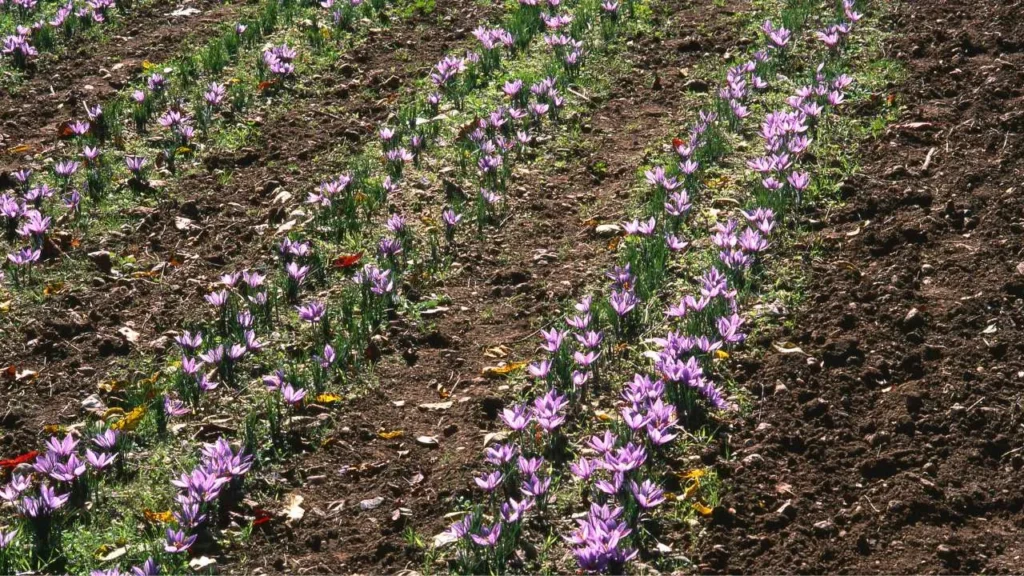
It is the ancient procedure in Kashmir and other countries that produce saffron.
- Where it Grows: Works best in areas with tons of heat and extreme dryness in summer (dormancy phase) and abhorrent coldness in the winter/autumn (flower).
- Technique: Corms are grown in well-drained soil in small heaps. The plant has no artificial sources of water, sun, or heat.
- Advantages:
- Very minimal running costs annually.
- Soil-based authentic agriculture.
- Disadvantages:
- So much weather-dependent; frost or prolonged rain may destroy the harvest at any time.
- Only one harvest per year.
- Consumes a large amount of land.
2. Indoor Saffron Farming (The Home Grower’s Choice).
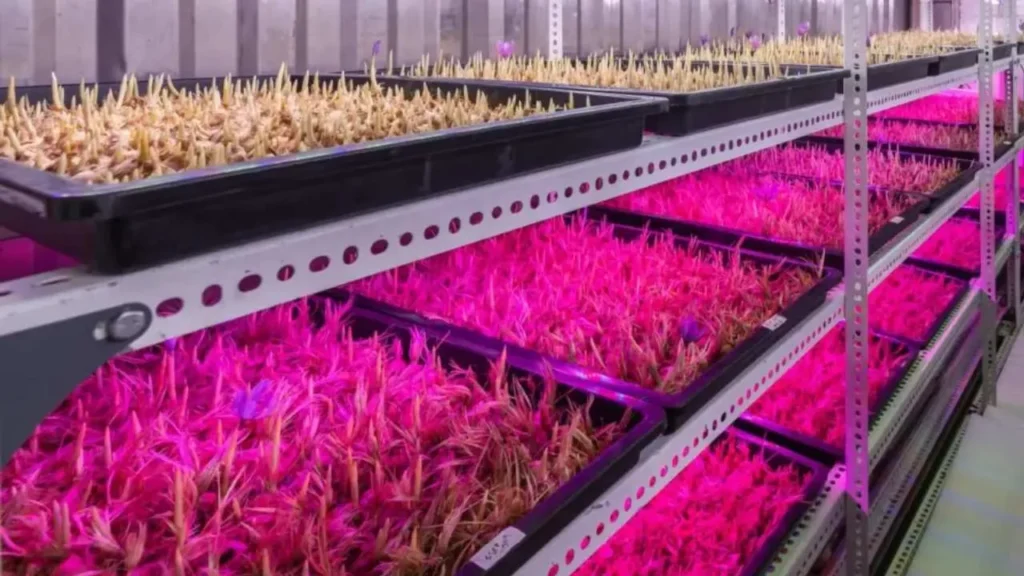
It is the most realistic method of cultivating saffron at home, whether you are in your local climate or not.
- Where it Works: Anyplace on the planet- either a warm South Indian or just a small apartment in a metropolitan area.
- Technique: Saffron corms were planted in containers, pots, or upright trays and arranged in an artificial environment (closing off a spare room, basement, or garage). The temperature, humidity, and light are artificially controlled.
- Advantage:
- Climate control (no threat of weather damage), Year-round production (with advanced methods), and yield per square foot (with vertical racks).
- Pest‑free environment.
- Disadvantages:
- Expensive start-up (chillers, humidifiers, and grow lights).
- Needs power to control the climate, and this raises the cost of operation.
3. Advanced Aeroponic and Hydroponic Saffron Farming.
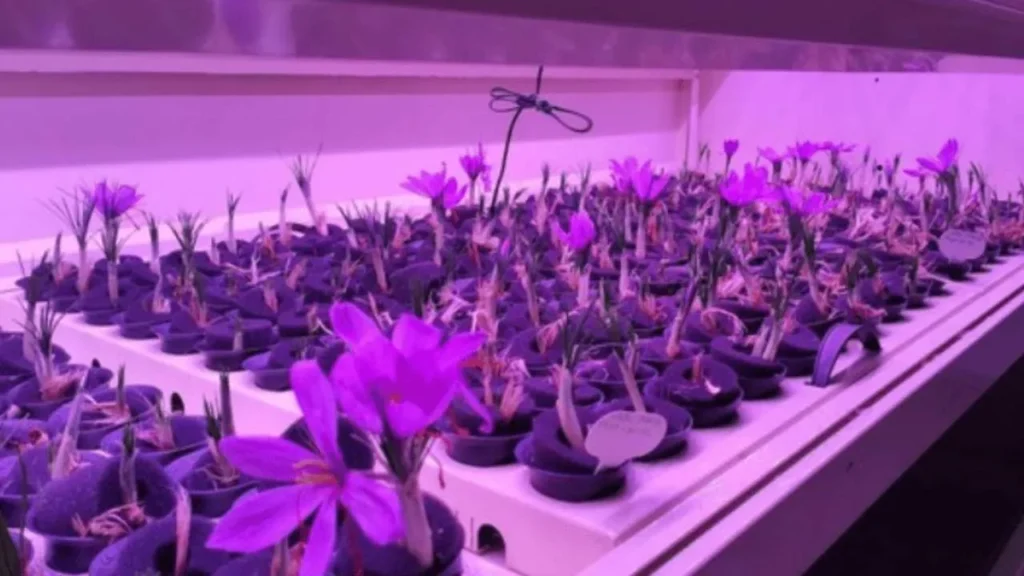
These are the new state-of-the-art, soil-less agriculture that bring indoor farms to a new level.
- Hydroponics: Corms can be cultivated in a non-living medium such as coco-peat or clay pellets, and a high-nutrient water solution is applied to the corms.
- Aeroponics. The corms are hung without touching the ground, and their roots are sprayed with a nutrient solution frequently.
Advantages:
- Maximum production at minimum area.
- Very high efficiency in the use of water and nutrients.
- Their growth cycles were even shorter and could have even had more than a single harvest annually.
Disadvantages:
- Extremely expensive to install and complicated.
- Needs continuous observation of pH, nutrient level, and condition.
- Certainly not a beginner or a technical imbecile.
Step-by-step tutorial: How to become a Saffron farmer in your own home.
Ready to plant your “Red Gold”? Use these steps to have a fruitful harvest in the house.
Step1: Basics of Saffron farming
Our step below involves knowing the basics of Saffron farming.
Saffron is not cultivated out of a seed. It is an outgrowth of a corm (that resembles a bulb, but small like an onion).
What is a Corm?

It is a bulging subterranean tip. This corm is a store of food, and it is here that the saffron plant derives its food supply in order to shoot off leaves and flowers.
- The Key Components: The plant is a producer of purple flowers. The stigmas, the three colorful red threads within the flower, are the spice of saffron when dried.
Step 2: Selecting the correct one of Saffron.
It has only one species: Crocus sativus. Nevertheless, you need to pay attention to the quality and size of the corms.
- It Is All about the Size: Size is a determining factor on whether the corm will be able to flower in its first year and the number of new corms it will bear.
- Big corms of 810 cm or larger, preferably, are required to produce flowers in the first year.
- In the first year, smaller corms will not grow more than the growing leaves and multiply.
- Sourcing: Get your corms from a certified supplier. Search firm, disease-free, and healthy corms. Ensure they have a Phytosanitary Certificate when purchasing them in another region or country.
Step 3: Decide on the method of Farming.
Choose whether to go outside (when the climate conditions are appropriate) or indoors (when it is a good idea, as it is consistent and more efficient the first time).
- iPad: Dine in your garden, within or upon a balcony, or a terrace. Needs to be in the natural sun and some suitable soil.
- Indoor: It needs a special room, and it has to invest in climate control. We shall be discussing the container/pot because it is homey and easy.
Step 4: Prepare the Planting Place.
Saffron is highly sensitive to its surroundings, particularly drainage.
- The corms will rot due to overwatering or poor drainage.
- An Italian mix of sandy and loamy soils, which are well-drained.
- Add as much organic material as possible, such as compost or well-decomposed manure, as a way of enhancing the fertility and texture of the soil.
To make sure the potting mix is excellent in terms of drainage, you can also add sand or even fine gravel to it.
- The optimum pH is a bit acidic to neutral (6.0-7.0).
- Containers: This should be in pots or containers that are at least 6 to 8 inches deep and good drainage holes. Saffron corms should be planted in groups and not in rows. A single pot can hold 10–12 corms.
- Sunlight: Saffron requires sun- right from the beginning of growth, it requires 4-6 hours of direct sunlight every day. When you grow inside, you need to be using full-spectrum LED grow lights, 10-12 hours a day.
Step 5: Plant Saffron Corms
Good planting is the key to a good harvest.
- Corns: The corms of the lily should be planted in late summer or early autumn (the months of August and September). To prepare the corms to flower in the autumn, they require the heat of summer.
- Depth: Plant the corms approximately 3 to 4 inches (810 cm) deep. Plant a shallowly (not more than 6 inches/ 15 cm) if in a very cold place to provide more insulation.
- Spacing: Space the corms 3 to 4 inches (810 cm) apart. Plant them near each other in a pot.
- Orientation: Ensure the sharp end of the corm is up. It is there that the shoot will grow.
Step 6: Care and Maintenance
The saffron is not complicated to take care of, yet there are consistency issues.
- Watering. Water sparingly! Saffron prefers a dry climate. But do not keep the soil dry or wet. Water when evaporation is all over the upper soil.
- Corroting of the corns can be largely attributed to over-watering. When there is no rain, light watering every 15 days is normally sufficient.
- Weeding: Weeds should never be allowed to grow in the place of saffron, as they also compete with the plant for food.
- Fertilising: Fertilising of saffron does not require a lot of food. It can be some organic compost or well-rotted cow manure prior to planting. Balanced NPK fertiliser may be applied at the beginning of spring when the leaves are developing to increase the multiplication of the corms.
Step 7: Flowering and Harvesting
The seventh step involves flowering and harvesting. This is the exciting part! The magic occurs during the autumn, usually 68 weeks after planting.
- Floweration: There will be beautiful purple ones. Not every corm will be flowering within its first year of growth, nor yet are they fruitless, but multiplying in preparation for the next generation.
- The Saffron: Within the purple one, you shall have three very thin and bright red stigmas (the saffron threads) and two yellow stamens, which are discarded.
- Harvest: The flowers bloom and dry within 2-3 weeks. The flowers should be picked in the morning as they appear.
- Gently pluck the flower: Using tweezers or your fingers, remove the three red stigmas from the flower. This step is the most labour-intensive.
- Separate the red stigmas and the yellow stamens. The saffron colour is only on the red.
Step 8: Drying and Storing of Saffron.
The eighth step is the drying and storing of Saffron. Saffron is dried properly so that its colour, aroma and value are retained. Dried saffron threads need to be dried immediately.
Spread the threads on either a paper towel or one with a fine mesh sieve.
- Traditional: Dry them in a warm, dark and well-ventilated place within several days.
- Fast Process: In a food dehydrator or an oven with the lowest temperature (approximately 50 C/122 122°F), you can dry them in about 10-20 minutes, but you have to monitor them carefully before they burn.
- Result: The threads ought to attenuate nearly 80 per cent of their weight, and become hard and brittle. They will get a dark to red colour.
- Tips: Your dry saffron should be kept in a closed container, preferably in a glass in a cool, dark place. Its quality can be preserved year after year in proper storage.
Step 9: Indoor & Aeroponic installation expenses (Optional)
In case you want to grow indoors, here is a ballpark of the cost. This is a short-term investment that would yield in the long term.
Step 10: Profitability Analysis (Real-Life Situation)
A small indoor installation of 100 sq ft (roughly 10 m 2 ) will be considered.
- Corms Planted: 1000 kg/m 2 x 10 m 2 (conservative estimate)
- Age-adjusted Yield (since Year 2): Approximately 2 gm/m of dry saffron per annum.
- 10 m² × 2 grams/m² = 20 grams per year.
- Market Price (Retail): An assumed moderate retail price of 300 per gram.
- Total Revenue/year = 20 grams x1/300 = 6,000.
- Greater yield: Assuming a very optimistic yield of 4 grams per m 2, the amount of revenue will be 12,000 at the same area.
Step 11: Marketing and Selling Saffron
To maximise revenue, target the market.
- Stress Purity: The principal message of your selling is that your saffron is mixed-free, 100% pure, and farm-fresh. Present the product in small and good glass jars.
Target Market:
- Direct-to-Consumer (B2C): You sell directly to individuals through social media, local farmer markets, or a simple online store. This gets the highest price. Target gourmet chefs, best bakers, and those who love health and beauty.
- Local Businesses: Collaborate with local bakeries, fancy restaurants, or Ayurvedic doctors.
- Branding: Call your product in a high-quality, believable manner. Include information regarding your clean growing practices and, in particular, whether indoors or aeroponic.
You Might Like: How to Start a Dairy Business
Conclusion
To begin a saffron farm in your own place, you will have to wait, work hard, and spend a bit of money if you would prefer an indoor route. It is a long-term business; the actual profit lies in increasing the number of corms every year.
Assuming you would like some rewarding hobby, a constant supply of pure spice, or the foundation of a minor business, the cultivation of the so-called Red Gold can become a possibility and an exciting task. Get the sleeves rolled up, put in the corms, and wait to see the pretty, money-making purple flowers.
FAQs
If I live in a climate without cold, do I still need to grow saffron?
No. Conventional farming requires cold conditions, but with indoor techniques, you can easily grow saffron in a spare room or basement by managing temperature and humidity.
Can I grow saffron from seed?
No, saffron is a sterile hybrid, which is not a good seed producer. Grow out of a special underground stem known as a corm (or bulb).
The amount of saffron that one corm will produce.
The form of the first year will tend to give a single corm only 1 to 2 flowers, and only about 3 to 6 threads. The true worth of this is that it will provide you with new baby corms every year, and you will be harvesting more and more.
When should the saffron corms be planted?
The best time would be at the end of summer (late) or at the beginning of autumn (early) (August-September). This heats up the corms, and then the cold causes them to enter the flowering process in October-November.