

The Indian startup ecosystem is still among the most vibrant and rapidly evolving ecosystems worldwide, with more than 140,000 startups registered as of early 2025. Such a spiralling ecosystem is a strong driver for new ideas, job creation, and measurable economic growth. Various factors, including significant government support that comprises a robust startup scheme structure to provide easy access to capital and markets while regulatory issues are addressed, underscore the country’s struggle with entrepreneurship.
Besides that, the government’s willingness to invest has attracted a lot of money, such as the ₹10,000 crore corpus that SIDBI is managing under the Fund of Funds for Startups (FFS) to bring in an aggregate investment of ₹60,000 crore into the ecosystem. Finding your way through these different government schemes is an indispensable initial step for any startup founder.
In this article, we will detail the essential requirements for being considered a startup in India and outline the top government schemes for startups in india available in 2026, offering a clear guide to securing funding and support.
Who is Considered a Startup in India?
A startup is officially recognised by the Department for Promotion of Industry and Internal Trade (DPIIT) when it fulfils the following conditions:
- Period of Incorporation: The point of incorporation or registration should be within ten years from the date of application for DPIIT recognition, thereby ensuring support for relatively new businesses.
- Annual Turnover: Annual turnover for any of the financial years from the year of incorporation should not be more than ₹100 crore, keeping the initiative alive for small and medium-scale enterprises.
- Innovative & Scalable: An enterprise should invent, develop, or improve products, processes, or services, or have a scalable business model that can create a lot of wealth or employment very quickly.
- Type of Entity: The business should be a community private limited company or a partnership firm registered in India, or a limited liability partnership (LLP) under the respective legislation.
- New Entity Status: The company must not have come into existence out of an already existing one, either through a split or a merger.
How to Register a Startup under Startup India
DPIIT recognition is like a golden ticket to most government schemes for startups and the benefits that go along with them. It is a hassle-free procedure comprising the following steps:
- Get Documents: Get the Certificate of Incorporation/Registration and, in addition, if it’s necessary for your kind of startup, get a recommendation letter from an incubator or a recognised industry body.
- Access Portal: Head to the official Startup India site and submit the registration form online.
- Give info: Provide all necessary details of your company, such as the business nature, information about directors, and other required financial info.
- Put Certification: Attach the documents requested in the guidelines, like the certificate of incorporation and innovation or concept proof.
- Get Recognition: After the verification process is accomplished successfully, the DPIIT Recognition Number, which is required for application to a particular government scheme for startups, will be with you.
Top Government Schemes for Startups (2026)
1. Startup India Initiative
The Startup India Initiative was established in 2016 with the primary objective of building an environment that would not only support but also encourage innovation and entrepreneurship all over the country. The system achieves this through an integrated framework covering policy support, tax benefits, and more straightforward compliance for qualifying startups.
Moreover, the establishment of a Fund of Funds for Startups (FFS) and a 3-year tax holiday on profits are the central elements of the initiative that considerably alleviate the initial financial burden of a startup. Besides that, the initiative permits self-certification under labour and environmental regulations, which means that the operating conditions are remarkably simplified for newly born businesses.
- What you get: 3 years of tax exemption on earnings (Section 80-IAC), access to Fund of Funds (₹10,000 Cr corpus) through VCs/AIFs, self-certification for 9 labour and 3 environmental laws, and easy company registration (SPICe+).
- Eligibility: Company must be Private Ltd / LLP / Registered Partnership; incorporated within last 10 years; annual turnover ≤ ₹100 crore; original entity (not from merger/split); business must be innovative or scalable.
- Best For: Any DPIIT-recognized startup that requires tax relief and regulatory simplification.
- How to Apply: First, obtain DPIIT recognition via the Startup India portal. Then, file an application for Section 80-IAC certification (for tax benefits) with the Inter-Ministerial Board.
- Link: https://www.startupindia.gov.in/content/sih/en/home-page.html
2. Startup India Seed Fund Scheme (SISFS)
The Startup India Seed Fund Scheme (SISFS) was launched in 2021 to address the funding gap, which was a major reason for the struggles of early-stage startups. These startups struggled to go beyond a proof of concept and deliver a market-ready product. In fact, it offers the money required for the staff of such companies to try the product and conduct initial market validation.
Additionally, the scheme is supported through eligible incubators across the country, and in many cases works in coordination with financing channels such as government banks in India that help strengthen the early funding ecosystem. Further, the total outlay of ₹945 crore is intended to support a large number of startups, making it one of the most direct government schemes for startups needing early capital.
- What you get: Grants up to ₹20 lakh for prototype development/market entry, investment up to ₹50 lakh via convertible debentures/debt-linked instruments, and access to incubators across India.
- Eligibility: Must be DPIIT-recognised; incorporated within last 2 years; recommended by eligible incubator; scalable business model; seeking early-stage funding.
- Best For: Early-stage startups that require seed capital for product development, trials, and market validation.
- How to Apply: You can only apply to an incubator that is eligible and approved by SISFS and is listed on the Startup India portal.
- Link: https://seedfund.startupindia.gov.in/
3. Fund of Funds for Startups (FFS)
Established in 2016, the Fund of Funds for Startups (FFS) functions as a vehicle meant to widen the pool of capital available to the ecosystem. In a manner that is quite different from the usual rationale of direct startup investing, SIDBI, which manages the ₹10,000 crore corpus, undertakes the task of infusing fresh capital in the Venture Capital (VC) and Alternative Investment Funds (AIFs) that are registered with SEBI.
Additionally, the program is opening doors to both new and expansion-stage companies through the offering of the necessary Capital to VCs and AIFs to extend their investment activities into the innovative startups.
- What you get: Indirect access to capital, which is channeled through SEBI-registered VCs/AIFs. These VCs/AIFs then invest in DPIIT-recognized startups.
- Eligibility: Must be DPIIT-recognised; to get funding via VC / AIF that uses FFS corpus; applicable for startups and expansion-stage companies.
- Best For: Startups that are looking for institutional funding from VCs or AIFs, in particular, those in the less developed areas or in the niche sectors.
- How to Apply: Get in touch with SEBI-registered VCFs or AIFs that are on the list of FFS beneficiaries.
- Link: https://www.sidbivcf.in/en/funds/ffs
4. Pradhan Mantri MUDRA Yojana (PMMY)
The Pradhan Mantri MUDRA Yojana (PMMY), which was established in 2015, focuses on how to provide micro-financing to micro and small enterprises (MSEs), among which are startups in the service and small trading sectors. The loans are observed as three different products are made -Shishu (up to ₹50,000), Kishor (up to ₹5 lakh), and Tarun (up to ₹10 lakh)- that take care of the varying financial needs of the borrowers.
Besides that, PMMY is actively pushing for self-employment and more extensive entrepreneurship among the non-corporate, non-agriculture small-business community. It is one of the most accessible and significant sources of small-scale capital among the different government schemes for startups.
- What you get: Loans up to ₹10 lakh without the need for any collateral are given under three different categories: Shishu (up to ₹50,000), Kishor (up to ₹5 lakh), and Tarun (₹5 lakh-₹10 lakh).
- Eligibility: Must be micro or small enterprise in non-agriculture sector (manufacturing / trading / services); non-corporate/small business; loan amount per MUDRA categories.
- Best For: Micro-enterprises, small businesses, and startups that require working capital or small-scale equipment financing.
- How to Apply: Take your application to the Member Lending Institutions (MLIs), such as banks, NBFCs, and MFIs, directly.
- Link: https://www.mudra.org.in/
5. Stand-Up India Scheme

The Stand-Up India Scheme, which was introduced along with the Startup India mission in 2016, is a social business promotion program in the Indian economy. The fundamental aim of the scheme is to provide a facility of bank loan to a minimum of one SC/ST and one woman in the locality of a bank branch, with the amount ranging between 10 lakhs and 1 crore rupees to set up a greenfield enterprise.
Besides that, the establishment could be in any of these sectors: manufacturing, services, or trading. In many cases, these loans are also supported through financial institutions such as a small finance bank in India, which further expands access to credit for new entrepreneurs. Moreover, the scheme allows a repayment period of up to 7 years with a moratorium of 18 months, which is quite a comfortable financial arrangement for new businesses.
- What you get: A bank loan between ₹10 lakh and ₹1 crore for a greenfield project, a repayment period of up to 7 years with an 18-month moratorium.
- Eligibility: Applicant must be SC/ST or Woman entrepreneur; starting a greenfield enterprise in non-farm sector; loan for new business between ₹10 lakh-₹1 crore.
- Best For: The first-time entrepreneurs from SC/ST communities and women entrepreneurs setting up their first venture.
- How to Apply: Online application through the Stand-Up India portal or a bank branch directly.
- Link: https://www.myscheme.gov.in/schemes/sui
6. Credit Guarantee Fund Trust for MSMEs (CGTMSE)
The Credit Guarantee Fund Trust for MSMEs (CGTMSE), a project since 2000, is aimed at the Micro and Small Enterprises (MSMEs) sector, which includes startups, in getting institutional credit without traditional collateral.
The fund offers a cover for the lending financial institution, thus making it less risky for them to provide collateral-free loans up to ₹2 crores. Moreover, the guarantee covers both short and long-term loans for capital expenditure and working capital requirements, making it one of the best government schemes for startups.
- What you get: Credit guarantee cover for collateral-free loans, including term loans and working capital facilities up to ₹2 crores.
- Eligibility: Must be Micro or Small Enterprise; eligible for collateral-free or partially collateral-free credit; can be existing or new enterprise seeking loan.
- Best For: MSMEs/startups who need loans up to ₹2 crores but do not have the collateral to secure them.
- How to Apply: The borrower applies for a loan at a Scheduled Commercial Bank or NBFC; the lender then sends the guarantee application to CGTMSE.
- Link: https://www.cgtmse.in/
7. MSME Ministry Support Schemes
The Ministry of Micro, Small & Medium Enterprises (MSME) is the principal ally of Startups after they register as MSMEs. The Schemes offered by the ministry are not only funding-centric but also focus on aspects like technology up-gradation, quality enhancement, and broadening market reach. For instance, the Credit Linked Capital Subsidy Scheme (CLCSS) enables a 15% capital subsidy for technology up-gradation, capped at ₹15 lakh.
Besides that, schemes like ISO Certification Reimbursement and International Cooperation Scheme help MSMEs to achieve global quality standards and easy participation in international fairs.
- What you get: Capital subsidy for technology up-gradation (CLCSS), reimbursement of expenses for ISO certification, financial assistance for participation in the international fairs, and preference in government procurement.
- Eligibility: Enterprise must qualify as MSME per investment/turnover norms; eligible for subsidies, tech upgrades, ISO reimbursements, market support etc.
- Best For: Startups that are manufacturing-focused, looking to upgrade technology, and wanting to expand to the global market.
- How to Apply: Directly to the Ministry via the related local offices or banks for each program.
- Link: https://msme.gov.in/
8. Atal Innovation Mission (AIM)
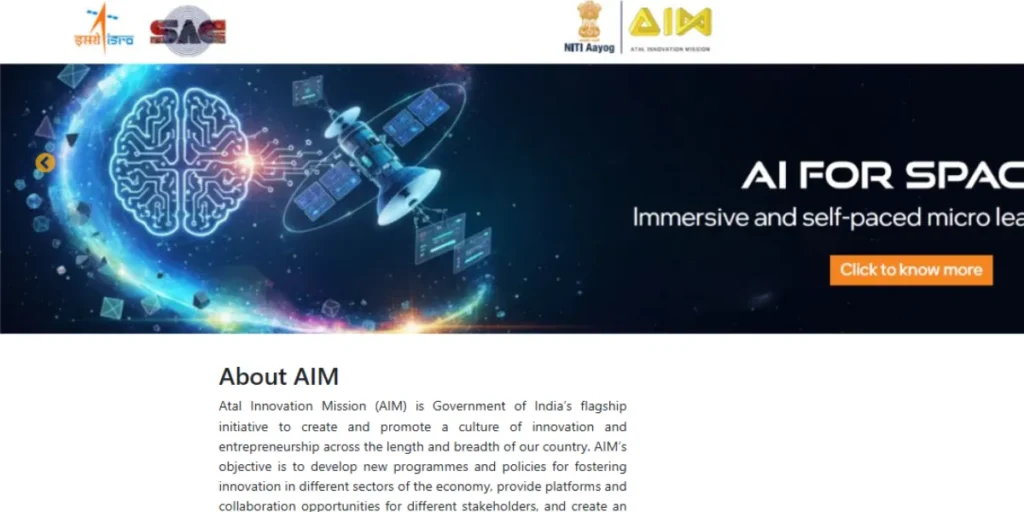
Atal Innovation Mission (AIM), NITI Aayog’s flagship initiative, aims to develop an innovation and entrepreneurial culture all over India. It majorly works through the core supports, especially Atal Tinkering Labs (ATLs) in schools, being the foremost, to promote innovation at the youngest possible age, and Atal Incubation Centers (AICs) to offer space and initial funding to new ventures.
Besides, AIM regularly funds programs, supports mentors, and partners to build a complete pipeline for innovation. Moreover, this is one of the essential government schemes for startups, which not only aids innovation at the corporate level but also at the grassroots.
- What you get: Subsidies for the creation of incubation centers (AICs), seed capital, organizing mentorship programs, and gaining access to an extensive network of academic and industry partners.
- Eligibility: Individuals/teams or institutions with innovative ideas; suitable for deep-tech, product-based or academic spin-offs; eligible for incubation, grants, mentorship.
- Best for: Tech startups, academic spin-offs, and deep-tech ventures that require institutional support and early-stage grants.
- How to Apply: You can submit your application through different challenge calls and application windows for AICs, ATLs, and specific programs available on the AIM portal.
- Link: https://aim.gov.in/
9. SAMRIDH Scheme
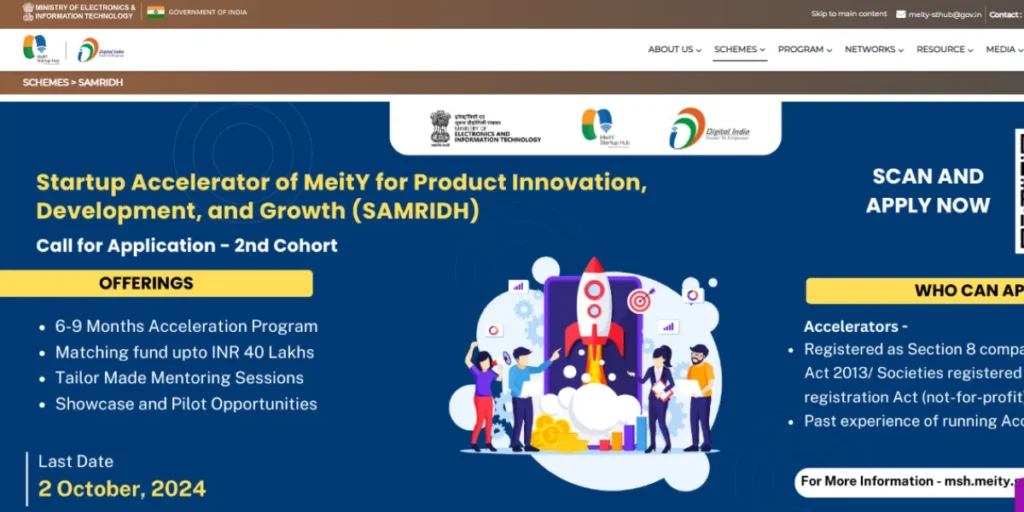
The SAMRIDH (Startup Accelerator of MeitY for Product Innovation, Development & Growth) Scheme, launched by the Ministry of Electronics and Information Technology (MeitY) in 2021, is a program that aims to grow product-based deep-tech startups quickly. It provides financial aid of up to ₹40 lakh per startup by co-investing with the respective angel investors or Venture Capitalists (VCs). Besides, a significant feature is the accessibility it offers through corporate accelerators to a broad range of mentorship programs, which are very important in product scaling.
- What you get: Financial support up to ₹40 lakh (co-investment), access to corporate accelerators, mentorship, and industry networks.
- Eligibility: Tech/product-based startups; must have prototype or minimal viable product; eligible for co-investment, accelerator support, and scaling aid.
- Best For: Deep-tech and product-based startups that have completed proof-of-concept and are in the stage of scaling.
- How to Apply: Submissions are only through the chosen accelerators and incubators, which are partners in the SAMRIDH scheme.
- Link: https://msh.meity.gov.in/schemes/samridh
10. E-Marketplace (GeM) for Startups
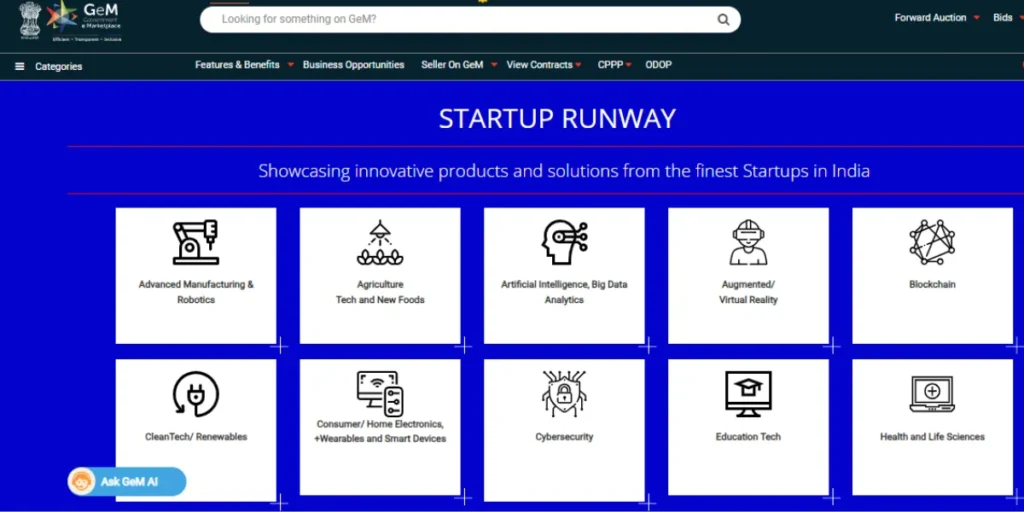
The Government e-Marketplace (GeM) is a web-based platform that makes the procurement of goods and services easier for the Central and State Government organizations, departments, and PSUs. The GeM for Startups program offers the most effective and straightforward way of government purchases to startups recognized by DPIIT.
In addition, registered startups are allowed to post the products and services they offer without the traditional pre-qualification criteria or tendering for particular orders. As a result, this increased exposure to government buyers is a significant advantage as it provides a ready market and raises the startup’s credibility.
- What you get: Direct access to government procurement, no tender requirements for specific orders, increased visibility, and exemption from Earnest Money Deposit (EMD).
- Eligibility: Must be DPIIT-recognised; register as seller on GeM portal; eligible to bid for government procurement without standard tender barriers.
- Best For: Startups that provide products or services that can be utilized by government departments, PSUs, or Ministries.
- How to Apply: To register on the GeM portal as a seller, choose the startup-specific category during registration.
- Link: https://gem.gov.in/Startup_Runway
11. MeitY Startup Hub (MSH)
The MeitY Startup Hub (MSH) is the national platform initiated by the Ministry of Electronics and Information Technology to support tech innovations in the IT, AI, cybersecurity, and fintech fields. The MSH backs the ventures financially and provides on-demand accelerator programs for tech-focused startups.
On top of that, startups get the golden chance to use government-funded R&D labs and can also be linked with industry leaders for mentoring & networking. In some cases, MSH also collaborates with ecosystem initiatives similar to a government franchise in India, helping startups access wider institutional support. In addition, MSH acts as a junction point for several other technology-driven government schemes that provide comprehensive support to the digital economy.
- What you get: Monetary assistance, accelerator programs, access to government R&D labs, mentorship, and networking opportunities.
- Eligibility: Indian companies (startup or otherwise) collaborating with academic or R&D institutions on electronics/IT/software projects; eligible for matching-grant support.
- Best For: Technology-intensive startups that require government-backed R&D infrastructure and top-tier technical mentorship.
- How to Apply: Submit your application via the MSH portal or through incubators and accelerator programs affiliated with MSH.
- Link: https://msh.meity.gov.in/
12. Software Technology Park (STP) Scheme
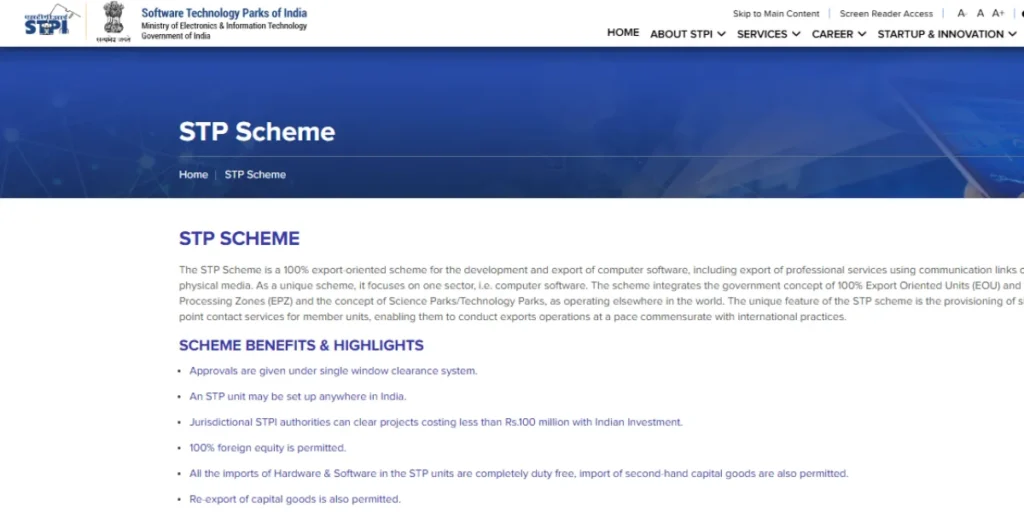
The STP Scheme has been utilizing the Indian IT and software export sectors as its focal point of growth since its inception in 1991. The scheme provides its beneficiaries a 100% tax exemption of profits generated by software exports, but for a specific period of time.
Additionally, it permits that capital goods for the business be imported free of any customs duties. Besides, it gives the opportunity to international-standard incubation and fast data communications, which, in turn, makes the organization highly attractive to the IT and software services exporters.
- What you get: 100% tax exemption on software exports; duty-free import of capital goods; access to the state-of-the-art infrastructure and incubation.
- Eligibility: Entities engaged in the export of software, including software services, with minimum prescribed export performance requirements.
- Best For: Software and IT/ITeS companies with a strong focus on exporting their services or products.
- How to Apply: Request for registration as an STP unit to the Software Technology Parks of India (STPI).
- Link: http://stpi.in/index.php/en/stp-scheme
13. Multiplier Grants Scheme (MGS)
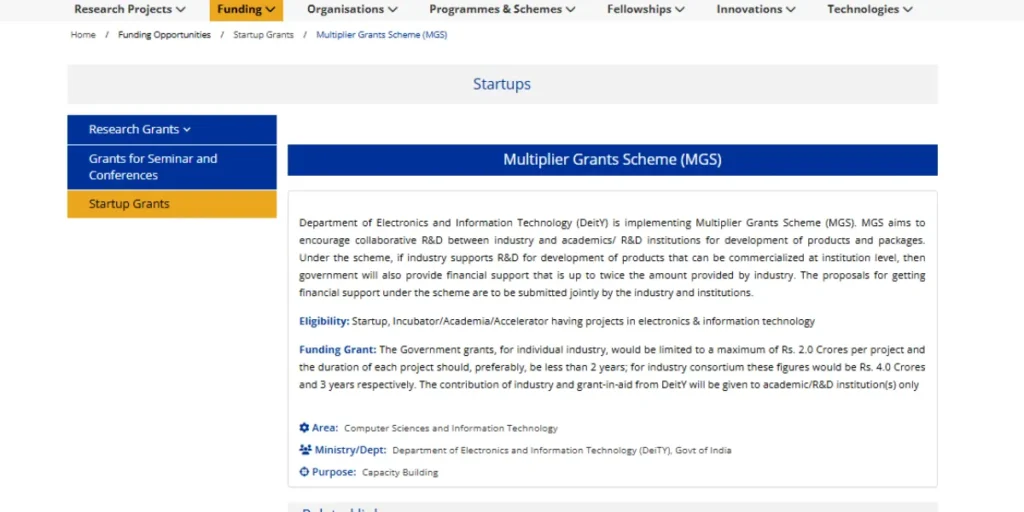
The Multiplier Grants Scheme (MGS) aims to increase intercollaboration between the industry and academia on R&D project issues mainly dealing with electronics, IT, and software development. MGS’s unique feature is that the government provides a matching grant equal to the amount contributed by the industry to an R&D project. Besides, the initiative offers up to ₹2 crore grants for projects of a single sector and up to ₹10 crores for joint ventures, substantially lowering the risks of R&D.
- What you get: Government matches industry contribution for R&D, grants up to ₹2 crore (individual) and up to ₹10 crore (collaborative).
- Eligibility: DPIIT-recognised startups in electronics/IT sector seeking international patents; eligible for reimbursement of patent-filing costs (up to specified limit).
- Best For: Startups with high-cost R&D projects, especially those in collaboration with universities or research institutions.
- How to Apply: You need to send your project proposal to MeitY by the time the relevant application window opens.
- Link: https://www.indiascienceandtechnology.gov.in/funding-opportunities/startups/multiplier-grants-scheme-mgs
14. Support for International Patent Protection in Electronics & IT (SIP-EIT)
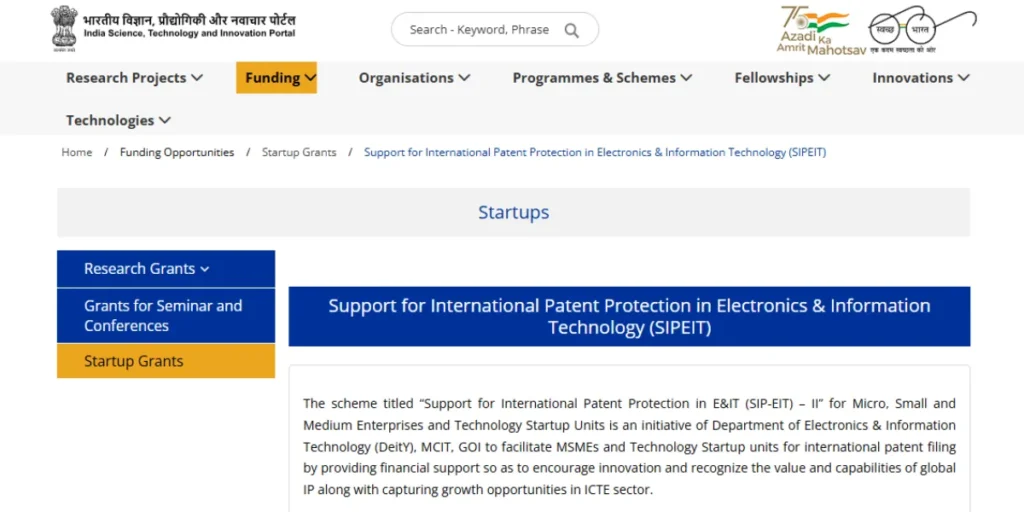
The purpose of the Support for International Patent Protection in Electronics & IT (SIP-EIT) is to assist Indian startups in the electronics & IT domain to secure their innovations with international patents. The patents are one of the most essential tools for IP protection and global market access. Along with that, the program provides generous financial assistance, up to ₹15 lakhs per patent for the foreign patent application, legal fees, and the patent office’s fees. Also, by alleviating the high cost of securing IP rights in foreign countries, this program equips Indian startups to compete internationally.
- What you get: Up to ₹15 lakh per patent is reimbursed for the international filing costs, attorney fees, and examination fees.
- Eligibility: DPIIT-recognized startups in the Electronics and Information Technology sector.
- Best For: Tech startups that have filed for a patent in India and intend to file the same patent internationally (e.g., via PCT or national phase).
- How to Apply: After the international patent filing, submit your reimbursement request to the authorized implementing agency (e.g., C-DAC, STPI).
- Link: https://www.indiascienceandtechnology.gov.in/funding-opportunities/startups/support-international-patent-protection-electronics-information-technology-sipeit
15. Dairy Processing and Infrastructure Development Fund (DIDF)
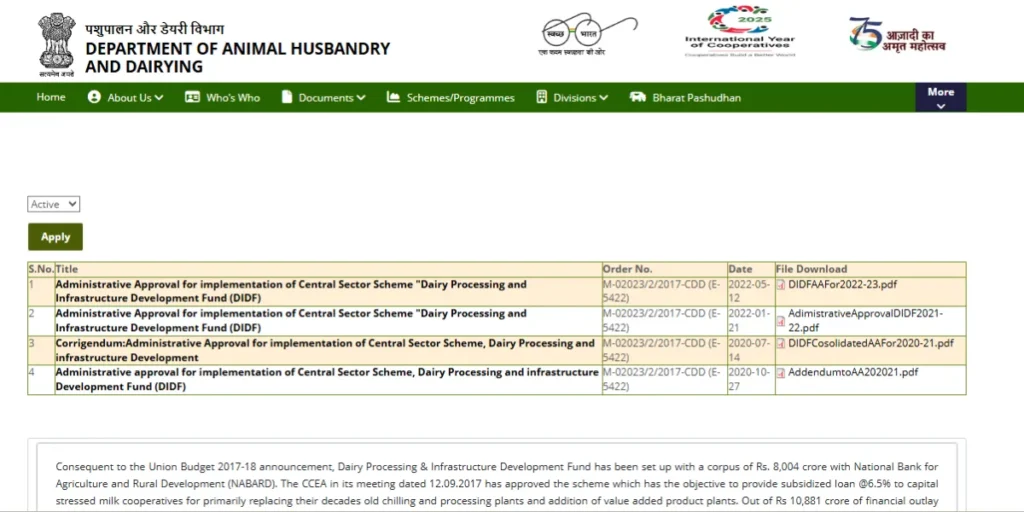
The Dairy Processing and Infrastructure Development Fund (DIDF) is a source of money allocated to the modernization and expansion of the dairy processing infrastructure of dairy startups and cooperatives. It provides long-term loans with low-interest rates for projects such as milk processing plants, chilling plants, and modern dairy equipment.
Moreover, the plan not only renews the entire dairy value chain but also facilitates the rise of the entrepreneurs’ efficiency and product quality. Additionally, DIDF is an essential sector-specific program among the government schemes for startups that injects the necessary capital for ventures in the vital agricultural and dairy sector.
- What you get: Loans over a long period with concessional interest rates, plus financial support for milk processing, chilling plants, and technologically advanced dairy equipment.
- Eligibility: Dairy cooperatives, State Federations, Milk Producer Companies, and private dairy entrepreneurs (including eligible startups).
- Best For: Startups and enterprises in the dairy processing and cold chain infrastructure development sector.
- How to Apply: Apply at the National Bank for Agriculture and Rural Development (NABARD) or at the National Dairy Development Board (NDDB) affiliated banks.
- Link: https://dahd.gov.in/schemes/programmes/didf
Support for Women Entrepreneurs
Here are some benefits offered by the government to support women entrepreneurs:
- Eligibility Criteria: Most of the schemes, such as CGTMSE and MSME-related programs, offer more guaranteed coverage or subsidies when an enterprise is owned or majority-led by women.
- Sector-Specific Funding: The Mahila Udyam Nidhi Scheme (from Punjab National Bank) is a program that uniquely meets the need for soft loans targeted at establishing new or upgrading existing small-scale projects by women entrepreneurs.
- Training & Capacity Building: The Ministry of MSME-led initiatives that provide specialized training and skill development programs for women fall within the scope of the department’s responsibility to cater to the needs of the female section of society.
- Marketing Support: The Assistance to Training Institutions (ATI) scheme sometimes makes available to women entrepreneurs provisions for trade fairs and exhibition participation at a subsidized cost, thereby facilitating access to the market.
How to Apply for Government Schemes for Startups
If you want to receive government funds for your startup, you must know how to apply. The general steps entail:
- DPIIT Recognition: One must first obtain DPIIT recognition, which is a prerequisite for almost all central government schemes for startups and their benefits.
- Scheme Selection: Choose the perfect scheme depending on your startup’s phase (seed, growth, or scale), industry type (deep-tech, manufacturing, etc.), and particular need (grant, debt, or tax relief).
- Incubator Connect: A recommendation or application through an approved incubator is required by many early-stage funding schemes, such as SISFS; hence, it is essential to be in touch with one.
- Documentation Prep: Make sure you have all the documents ready, such as a solid business plan, financial projections, pitch deck, and all statutory filings.
- Lender/Portal Application: Submit your application either via the official scheme portal (for grants/tax benefits) or through a financially authorized institution (for loan/guarantee schemes like MUDRA or CGTMSE) handling your case.
Conclusion
The terrain of government schemes for startups in India is vibrant and very supportive. Also, the government is continuously upgrading these schemes to harmonize with the needs of the ever-changing ecosystem.
Having a good command of eligibility criteria and the proper application process is necessary if one wants to make use of these resources efficiently. By strategically deploying these government schemes for startups, founders will be able to significantly reduce the risk of their startup journey and devote more time to innovation and growth.
FAQs
1. How does a startup qualify for the 3-year tax holiday under the Startup India Initiative?
Your company needs to be a startup recognized by DPIIT, meeting the conditions mentioned. It should not be more than ten years since its incorporation, have a turnover of less than Rs. 100 crores per annum, be engaged in any industrial, commercial, or service activity, and claim the deduction of any three consecutive years out of the first ten years of the company’s life.
2. What are the definite market-validation milestones of a startup for the Seed Fund Scheme of Startup India (SISFS)?
SISFS offers grant support (up to ₹20 lakh) for certified progress under the following main milestones: proof-of-concept, prototype development, product trials, and initial market entry; endorsement needs to be done by an accredited incubator.
3. What does “indirect funding” mean in the case of the Startup India Fund of Funds (FFS), and how do startups get it?
FFS (managed by SIDBI) is a source of capital for VCs/AIFs, not a direct one for startups. Through an investment from a SEBI-registered VC/AIF that has received funds from the FFS corpus, a startup can gain access to it.
4. How does the Credit Guarantee Scheme for Startups (CGSS) facilitate the raising of debt capital?
The CGSS offers a guarantee cover to the lenders up to Rs. 20 crore per startup who will avail of collateral-free term loans and working capital from banks and NBFCs, and thus greatly facilitates the process of eligible DPIIT-recognized startups receiving these loans.
5. What are the compliance advantages for startups under the Startup India Initiative?
Recognition as a startup will entitle one to self-certify compliance in nine labor and three environmental laws (thus reducing the number of inspections), use the streamlined SPICe+ form for company incorporation, and gain access to easier reporting frameworks, thereby saving both time and cost.